
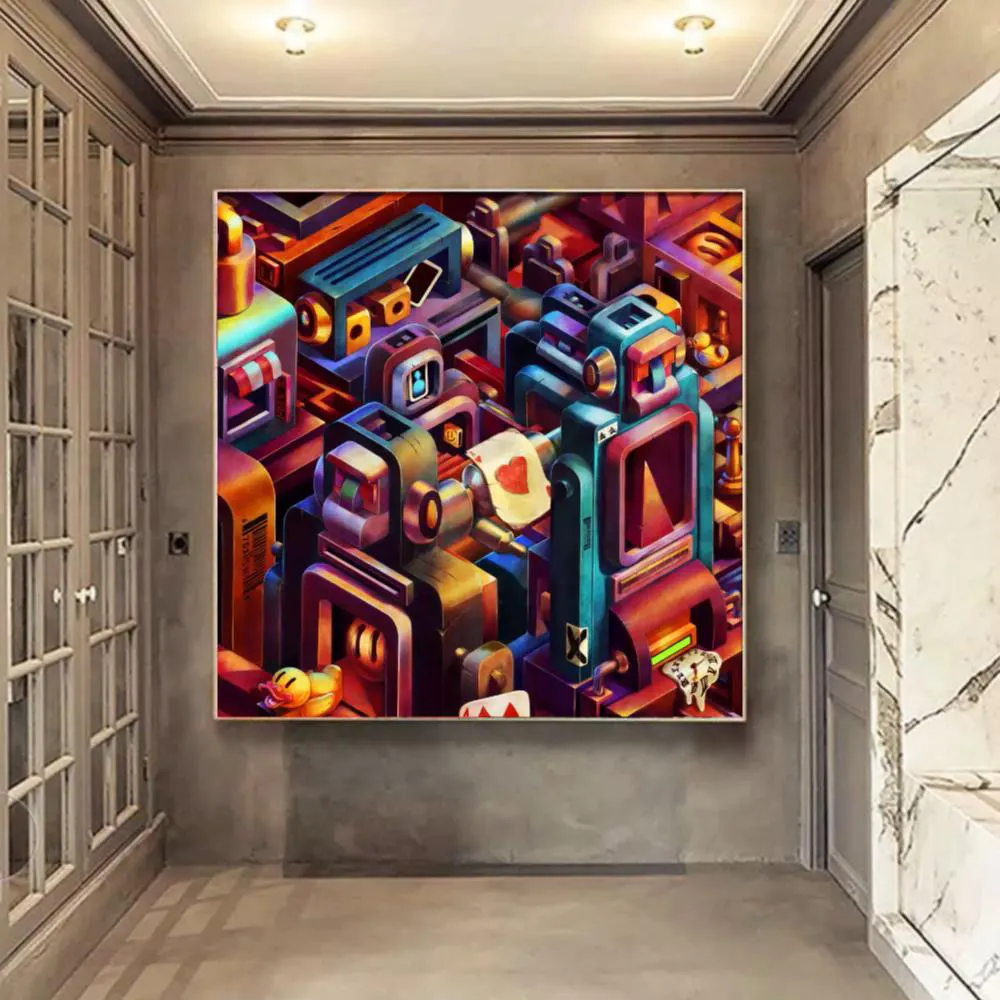
Today is November 25th. Without realizing it, we’re already standing at the edge of the year, preparing to welcome 2026. Time passes so quickly—like a morning cup of coffee that slowly cools while we’re busy thinking about tomorrow. If you’re reading this, I hope you’ve found your direction, rhythm, and plans for the coming year—a year that may bring new hopes as well as unexpected challenges.

Looking back at the past four years, I’ve come to realize that two years ago might have been the most productive period of my life. During that time, so many works, concepts, and collections emerged—Romantic Grotesque, Exquisite Aberrations, and Homo Ludens.
Yet among them all, it is Homo Ludens that continues to call me to dig deeper.
Within the Homo Ludens collection, I explore the idea of humans as beings who possess an existential need for play. Not play in its simplest sense, but play as a way through which humans interpret and understand the world.
It is within this space that social meaning emerges—meaning that is negotiated, exchanged, and collectively understood.
When humans step out of the world of play and into the realm of social life, they begin to build fictional narratives—stories, symbols, beliefs, and rules—that gradually grow into symbolic systems.
These symbolic systems eventually crystallize into social structures: the social orders we inhabit, uphold, and participate in, often without fully realizing that they are all built upon imaginative agreements.
Within this order, reality never stands on its own. It is shaped by the interwoven strands of interacting subjectivities.
This is intersubjectivity—the space where collective meaning is born, sustained, and passed down. As long as this shared understanding remains intact, society retains its direction and its sense of collective awareness.
Yet the intersubjective horizon is never static. It can fracture when the narratives that sustain it lose their elasticity.
When symbolic systems fail to adapt to the shifting tides of time, the social structures built upon them begin to falter.
At its extreme, this condition can give rise to what I call social extinction—the collapse of shared meaning that once allowed people to feel as though they inhabited the same world.
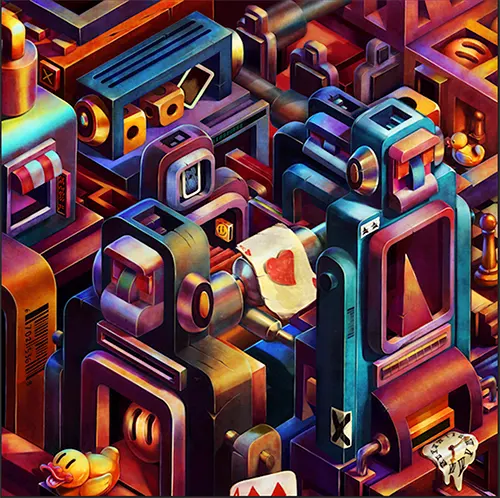
In my work Intersubjective Horizons, this experience is visualized through a structure of toy-like wooden blocks—simple in appearance, yet dense with symbolism.
Each block represents a value, a myth, or a belief that supports the architecture of social life.
The subtle frame-by-frame animation reinforces the idea that social order is a living organism—constantly moving, constantly adapting, and perpetually vulnerable to change.
As a utopian gesture, I believe that humans—Homo Ludens—always possess the capacity to construct new intersubjective horizons. Through imagination, creativity, and the playful act of meaning-making, we can redesign the world we inhabit.
As long as we continue to nurture intersubjectivity, social extinction will not easily take hold. We can always create new bridges of meaning—pathways that reconnect us to one another.
Perhaps, when you look at the work “Intersubjective Horizons,” you realize that it is more than a visual exploration. It reflects the fragility of the realities that surround us. Every belief we inherit, every symbol and image we repeat, and every story we choose to keep alive becomes an essential part of the collective knowledge and choreography that shapes who we are.
In this sense, the artwork becomes a quiet invitation—one that urges us to question the narratives that have long bound us together. To imagine new narratives, to transform the old ones that have begun to fracture, and to recognize the delicate threads of intersubjectivity that allow us to survive side by side. For without this shared horizon, even the most familiar world can lose its coherence.
Perhaps this is indeed the fundamental task of Homo Ludens: to continuously create meaning within the ongoing play of reality’s structure, and to preserve the symbolic and imaginative bridges that connect us—bridges that tie past to future, no matter what uncertainties lie ahead.
This concludes my reflection on Intersubjective Horizons.
Follow me ! .We will continue with the next work.