
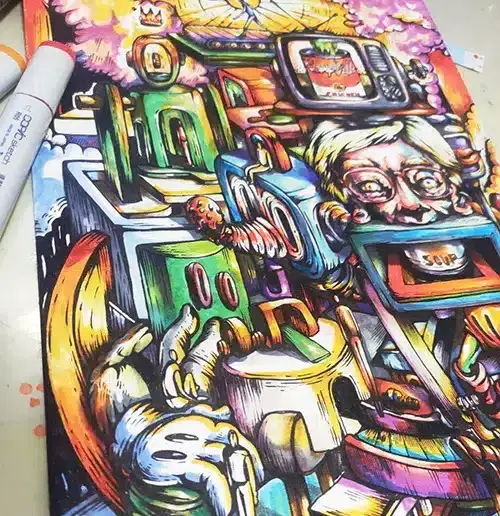
Mixed media art is a method and approach that uses two or more mediums as artistic tools, which are then brought together in a single work. It can take the form of conventional painting media such as ink, watercolor, or acrylic, but also unconventional materials like newspaper, coffee stains, or even recycled waste. For me, mixed media is more than simply combining materials—it speaks about new possibilities, exploration, the search for identity and form, the interplay between the raw and the refined, the imperfect and the polished. It embodies the human touch alongside the precision of digital art.
I guess one thing I never really thought about before was mixing traditional and digital techniques. For the longest time, I kept pushing myself to make digital work look “perfect,” as close as possible to the feel of traditional art. And honestly, that’s not impossible anymore—apps like Procreate and Photoshop have made it easy. They’ve got brushes that mimic oils, watercolors, inks—you name it. You can even make your own brushes, which opens up endless options for Procreate art ideas and experiments.
But then came AI. It’s smart, it’s fast, and it can generate images that look flawless. The thing is, they often feel too easy to predict. That whole chase for perfection—whether in digital art or AI—started to lose its charm for me. Instead, I’ve become more attracted to rawness: things that look rough, messy, and unpolished, yet feel more alive and honest.
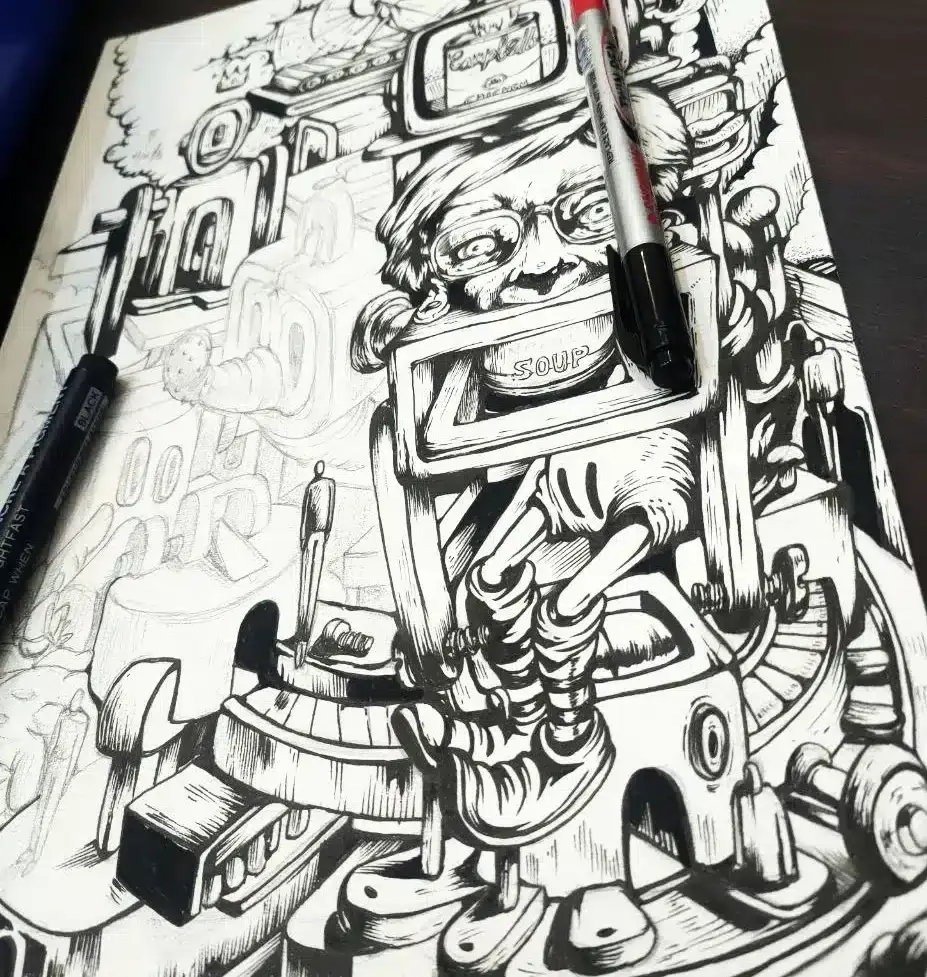
That’s what pushed me into making mixed media art—blending the honesty of traditional craft with the endless possibilities of digital tools. I don’t try to polish them too much; I actually like leaving things a little rough, a little raw. I’ve also been playing around with digital art ideas inspired by glitch, which takes digital “mistakes” or errors and flips them into something expressive.
A big part of my process comes from traditional drawing. I usually start on paper with pencil markers for the line art, then move into coloring. Marker art has always fascinated me because of its bold, solid tones. When I use alcohol markers, the saturation and layering effects add a vibrancy that feels alive. On top of that, I often bring in watercolor washes and gouache highlights, letting each medium interact with the others. This layering of textures is exactly what makes mixed media so unpredictable—and so rewarding.
After finishing the traditional stage, I scan the artwork and move to digital refinement. Procreate is one of my go-to tools, not just for its brushes but also for the ability to create animations, overlays, and textures. Some of my favorite Procreate art ideas include:
Taking alcohol marker drawings and enhancing them with glitch textures.
Using Procreate layers to experiment with transparency and distortion.
Mixing hand-drawn textures with digital brushes to emphasize contrast.
Most of the time, the last step in my process is digital animation or editing, where I bring in glitch effects. For me, glitch isn’t just an error—it’s a chance to create something new from imperfection. My digital art ideas often revolve around this: duplicating frames, warping colors, letting distortion become part of the narrative. The result is a hybrid artwork that is both raw and digital, both fragile and loud.
See the final artwork from this creative process, titled “Synthetic Reality.”