

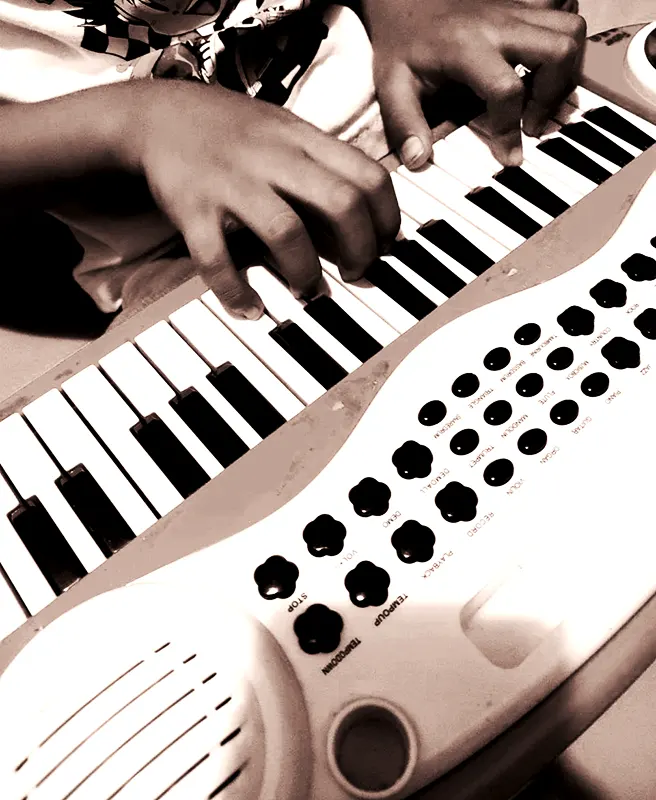
Speaking of prehistoric art evolution, right now, I am sitting down, enjoying a midday break from the busyness of painting in my studio, and heading out for a warm cup of cappuccino at a cafe. It feels incomplete to let such a quiet moment pass by doing nothing but daydreaming. As I unwind, I am waiting for my son, who is currently at his piano lesson. Lately, he has been incredibly passionate about exploring music and instruments—a wonderful surprise for my wife and me. For the longest time, he showed little interest in drawing or painting, even though he often watched me paint and has a remarkably sharp eye for evaluating my work. Naturally, my son is my number one supporter, always offering the sweetest words of encouragement. Immersed in this moment, I opened my laptop and began to reflect once again on the essence of art and aesthetics.
Sitting here, my mind naturally gravitates toward the grand trajectory of prehistoric art evolution. Before we can dissect the deep philosophical purpose of prehistoric art or challenge how Eurocentrism has shaped the oldest figurative art history, we often have to look back at our own personal artistic roots.
For me, my thoughts suddenly drifted back to a performance art piece I put together with a few friends—Eko, Budiono, Asep, and Milton—around 2005. Back then, completely unplanned, we decided to stage a spontaneous happening art event on campus. We had just moved into a newly constructed faculty building that was pristine and modern. However, the students there seemed passive; their routine revolved strictly around lounging around or simply attending classes. Seeing this lack of creative spark, our sudden intervention in the central hall of the faculty immediately captured everyone’s attention.
My performance aimed to provoke an existential awareness among the students: challenging them to question why they chose an art major and what the true essence of art is. Stripped to my waist and wearing only shorts, I wrapped my entire body and face in philosophy and aesthetics books, securing them tightly with duct tape. I walked around, approaching anyone I encountered, asking them a single question: “What is the purpose of your life?”
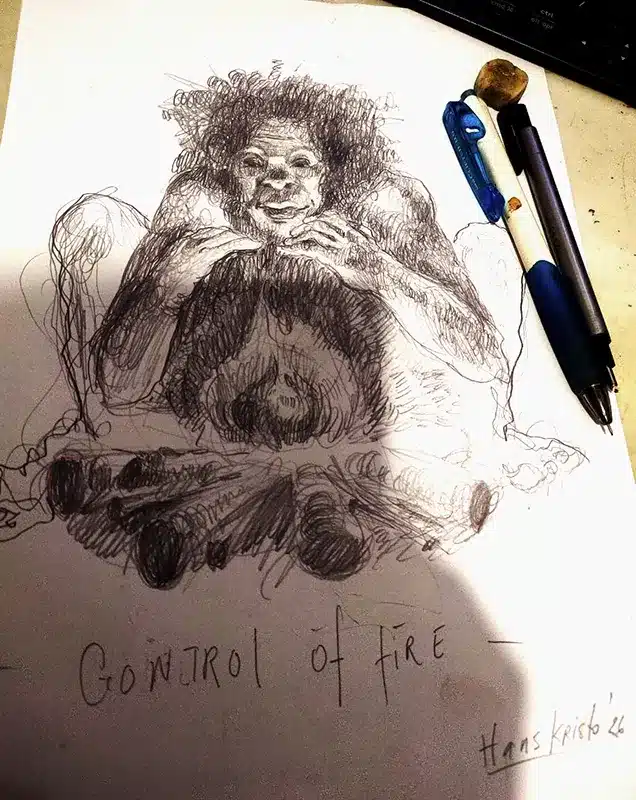
At that time, I was deeply consumed by questions regarding why we read art and philosophy books, and why these two disciplines must exist and be needed by humanity. This seemingly simple yet complex question did not receive a systematic answer back then—perhaps due to the unsystematic nature of my reading or a lack of references. However, looking back at the history of civilization, art and philosophical thought emerged precisely when humanity moved past the critical phase of mere survival, specifically when we harnessed the technology of fire. The discovery of fire changed everything. Humans could cook food to make it last longer, a stark contrast to the era when they had to hunt continuously and consume their catch immediately. Fire technology also made hunting more efficient, granting humans significant leisure time. At night, the warmth of the campfire meant humans no longer had to sleep early; They had the time to sit together, contemplate, converse, and exchange ideas about their evolving civilization.
The Evolution of Shared Fictions and Social Bonds Historians believe it was at this turning point that humanity began to conceptualize philosophy and art. They created new ideas concerning social structures, laws, communal rules, art, and religion. Yet initially, all these concepts served as “tools” for human connection and social bonding. In terms of social structure, humans began to recognize the figure of the tribal chief, who was revered as a spiritual leader or a wise elder capable of divination and embodying local wisdom—even if this knowledge was not systematic like modern science. Beyond leadership, these chiefs often served as healers. Yet, above all, the primary purpose of this social structuring was to connect individuals with differing thoughts to prevent mutual destruction.
There is a widely held sociological belief that ancient humans could not unite in groups larger than 150 people without the aid of “imagined realities” or fictions (such as religion, tribalism, nationalism, money, and culture). Through these shared fictions, humanity could establish a collective emotional bond.
However, a pressing question arises in this modern era: when we are constantly driven by capital and the pursuit of profit, a large portion of society must spend their entire lives merely working to survive. When leisure time is stripped away, it is no wonder that fewer people have the luxury to contemplate civilization or appreciate art and aesthetics. The reality is that art has often shifted into an exclusive commodity for the upper class—those who have escaped the daily grind of survival and thus possess the time to read books, ponder civilization, and admire art in museums and quiet gallery corners.
Although its value continuously shifts according to the spirit of the time (zeitgeist), art and aesthetics have fundamentally existed since prehistoric times. In the ancient era, art and aesthetics were deeply intertwined with religious rituals and the transmission of knowledge. We can find the earliest footprints of this aesthetic drive in the remnants left by cave dwellers in France, Spain, and notably, Indonesia. Several monumental milestones that disrupted the Eurocentric narrative of art history include:
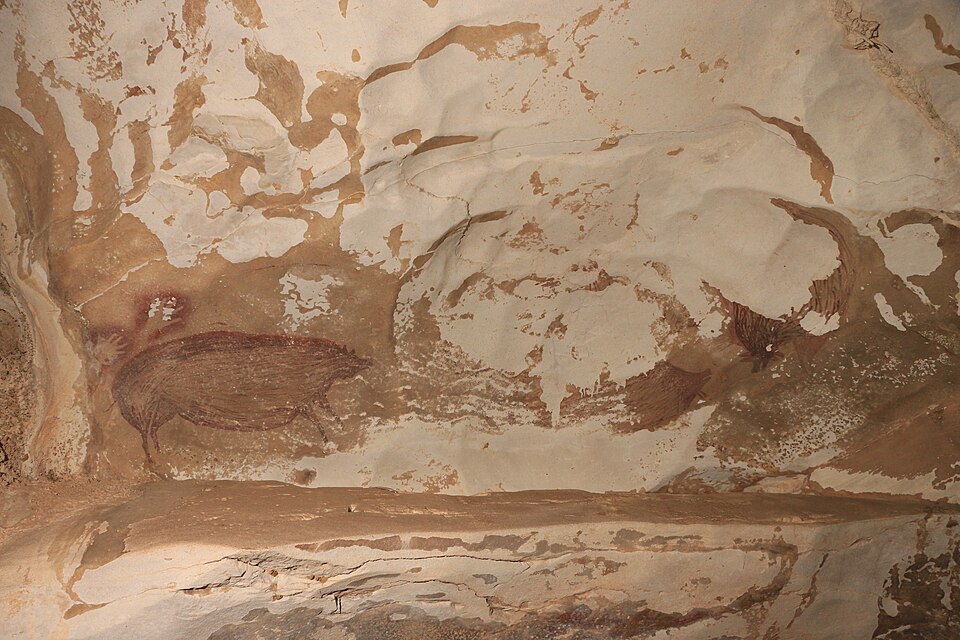
The prehistoric rock art panel at Leang Tedongnge, Photo by Basran Burhan, licensed under CC BY-SA 4.0.
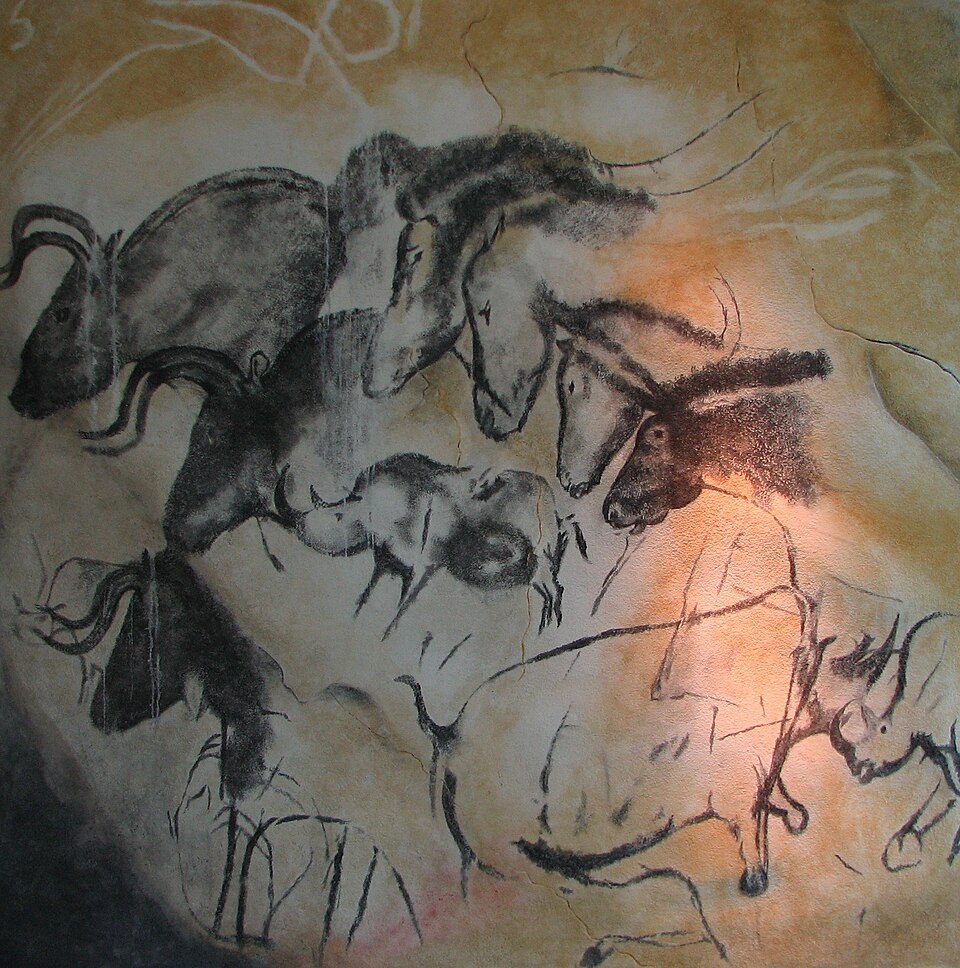
The dynamic drawings of carnivores inside Chauvet Cave, France (Source: Wikimedia Commons ).
The rich mineral-pigmented wall paintings of large fauna in Lascaux Cave, France. (Source: Wikimedia Commons ).

The explorations into ancient art continued to advance. In 1994, three speleologists discovered the isolated Chauvet Cave in France. The paintings inside featured depictions of carnivorous animals such as cave lions, rhinoceroses, and leopards, executed with advanced shading techniques and a sophisticated perspective of movement. Radiocarbon testing revealed that these cave paintings were approximately 36,000 years old. The Chauvet discovery firmly refuted the theory of linear evolution in ancient art. This remarkable display of skill proves that prehistoric art evolution was never a linear progression from primitive to advanced, but rather a sudden explosion of human cognitive complexity.
Previously, scientists believed that primitive art developed in a rigid, linear progression: starting from abstract forms, moving to stencils, progressing to simple animal silhouettes, and finally achieving shading and perspective. Chauvet proved this assumption wrong; cave dwellers thousands of years ago were already capable of creating complex shading and highly dramatic visual effects.
The ultimate disruption to the narrative of art history occurred between 2014 and 2019 through intensive research led by a team from Griffith University. This research officially rewrote the historical narrative: high art, long believed to have originated in Europe, actually began much earlier in Asia. Two stunning discoveries in Sulawesi shook the global art world: a hand stencil at Leang Timpuseng Cave dating back at least 40,000 years, and culminating in 2019 with a narrative hunting scene depicting therianthropes (part-human, part-animal figures) at Leang Bulu’ Sipong 4 Cave, recorded to be 43,900 years old.
Finally, a new record in the documentation of global figurative art history was broken. Archaeologists published an extraordinary find at Leang Karampuang Cave in Maros. Utilizing cutting-edge scientific dating methods, the figurative painting depicting ancient humans interacting with a wild boar was determined to be at least 51,200 years old—making it the oldest known cave painting in the world to date. These Indonesian cave paintings completely rewrite the global timeline of prehistoric art evolution, shifting the cradle of human aesthetics away from Europe.
This series of scientific breakthroughs proves that we will always be astonished by new discoveries. These findings do not just alter our perception of art’s value through the lens of history; they also remind us that art cannot be rigidly measured by our limited, contemporary viewpoints.
At times, art is inherently futuristic; it leaps past its own era, remaining incomprehensible to the people of its time. As researchers, observers, critics, scientists, and curators, we can only use our current understanding as a temporary variable to evaluate the visual expressions of the past. This means that all evaluations and research will continue to evolve alongside advancements in science, technology, and human civilization—and it is precisely this dynamic that makes the study of aesthetics endlessly fascinating.
The discussion above serves as an introduction to ancient art up to the discovery of cave paintings. Of course, there are many more visual art artifacts from the subsequent Stone Ages worth exploring, such as stone axes and hammers that hold both aesthetic and functional value. However, the fundamental conclusion we can draw is this: art in that era was never detached from its function as a tool for survival and a medium of information to understand the surrounding environment. In the next article, we will take a step further to dissect the classical aesthetics of the Greek era. Thank you for reading this article. Ultimately, looking back at prehistoric art evolution reminds us that art has always been about more than survival—it is the ultimate expression of our shared humanity.

I write about art, aesthetics, philosophy,
and the ideas behind my visual work.