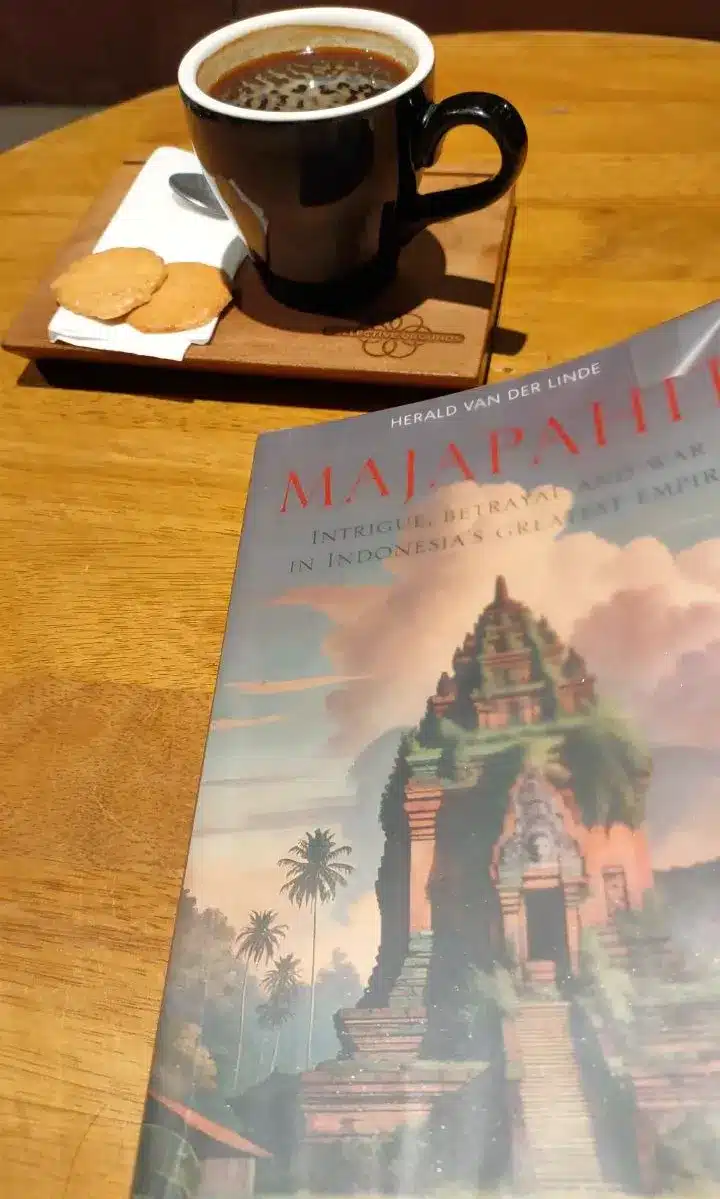
One book that has recently caught my attention is Majapahit, written by Herald van der Linde. Majapahit was one of the great kingdoms of Southeast Asia, with considerable influence and an extensive sphere of power during its time. In this Majapahit book review, I want to explore not only the history presented in the book, but also some of the questions and reflections that emerged as I read about the kingdom, its rulers, and its political struggles. My interest in this book is, of course, quite personal. Having been born in Indonesia and working as an artist, with a strong interest in culture, I have always been curious about how our society came to be what it is today. I often find myself looking back at the cultural roots of the communities around us, because the way we live today may have connections to events that took place centuries ago. There is a saying that history repeats itself. Whether or not that is entirely true, I feel that many aspects of the past can still be recognized in our present lives.
In this article, I will not attempt to provide a detailed summary of the book. Instead, this is a personal review of Majapahit by Herald van der Linde, focusing on several parts that caught my attention, particularly the perspectives, interpretations, and questions that came to mind as I read. Much like some accounts of ancient Greek history, where mythology and religious beliefs are often woven into historical narratives, stories about Majapahit also contain similar layers. We cannot simply accept every story as historical fact. But that does not mean these stories have no value. We can still explore the meaning behind them: why a particular story was told, why certain figures were portrayed in a particular way, and what interests or ideas might have been hidden within those narratives.
One of the interesting aspects of this book is how the history of Majapahit is reconstructed through various sources, from inscriptions and artifacts to travel accounts and ancient manuscripts. One important figure in the early European study of Javanese history was Thomas Stamford Raffles, a British official who governed Java during the period of British rule. He also served within the British East India Company.Raffles had a strong interest in Javanese history, culture, and heritage. He encouraged the collection and documentation of information about the island, contributing to the development of research into Java and Bali. One of his most important works was *The History of Java*, published in 1817. However, one distinction needs to be made: Raffles was not responsible for the discovery of the Nagarakretagama manuscript. It was discovered in Lombok in 1894 by the Dutch philologist J.L.A. Brandes, during a Dutch military expedition. The manuscript later became one of the most important sources for understanding Majapahit, particularly during the reign of Hayam Wuruk.The Nagarakretagama was written by Mpu Prapanca in 1365. He was a court official and a Buddhist religious figure in the Majapahit court. Through this work, we gain a picture of royal life, the king's journeys, the structure of government, territories connected to Majapahit, and the religious and cultural life of the period. What interests me is that much of our understanding of such a powerful kingdom has survived through the writing of a court poet. Of course, we also need to remember that the Nagarakretagama is not a neutral account in the way we might expect from modern historical writing. It was written within the royal court and contains praise for the king. Therefore, alongside its value as a historical source, it should also be read as a reflection of how Majapahit wanted to present itself.
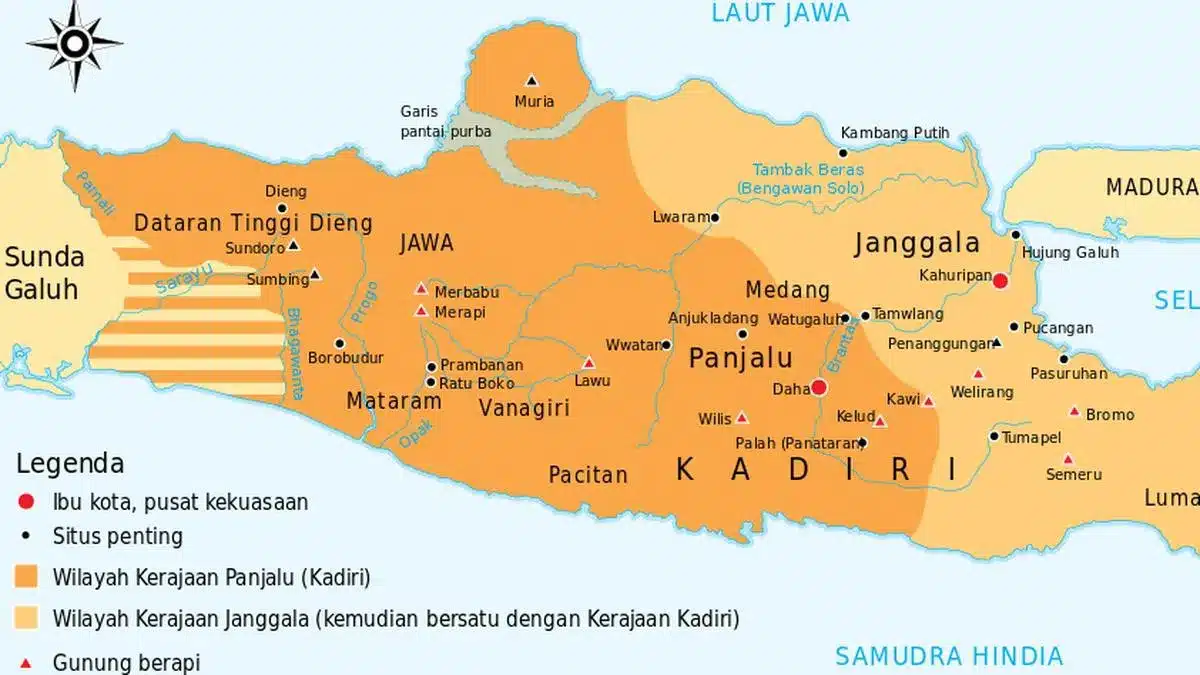
The history of Majapahit cannot be separated from the earlier kingdoms of East Java. One particularly interesting figure is Airlangga, a king who rebuilt political power in East Java following the collapse of the Medang Kingdom in the early eleventh century.Towards the end of his reign, Airlangga faced a problem of succession. His daughter, Sanggramawijaya, who was later associated in tradition with the figure of Dewi Kili Suci, chose a spiritual life rather than succeeding to the throne. Around 1042, Airlangga's kingdom was divided into two territories: Panjalu, also known as Kadiri, and Janggala.In traditional accounts, this division is associated with a spiritual figure named Mpu Bharada. According to the story, he flew through the air carrying a water vessel and poured water from it to mark the boundaries between the two territories. Another part of the story tells how his clothing became caught in a tamarind tree, which was later included in the explanation of how the boundary was established.For me, this story is interesting not only because of its mystical elements, but also because it shows how a political decision could be given legitimacy through a spiritual act. The division of territory was not simply an administrative decision made by a king. It was presented almost as an event sanctioned by religious authority. Over time, Kadiri became the more dominant power. Janggala eventually ceased to appear as an independent kingdom on equal footing with Kadiri. However, the relationship between the two territories and the process through which they were reunited were not as simple as one kingdom conquering the other in a single event.By the thirteenth century, Kadiri was ruled by King Kertajaya. According to the account in the Pararaton, tensions developed between Kertajaya and the Brahmin community. Some Brahmins are said to have sought protection from Ken Arok, the ruler of Tumapel.This is where the story of Singhasari begins to take shape. Ken Arok, who had previously ruled Tumapel, eventually challenged Kertajaya's authority. In 1222, his forces defeated Kadiri at the Battle of Ganter. This marked the end of Kadiri's dominance and the rise of Tumapel, which later became known as Singhasari.
One of the stories that caught my attention most is the story of Ken Arok and Ken Dedes. In the Pararaton, Ken Arok is said to have seen a radiant light coming from Ken Dedes when part of her body was accidentally exposed. He then sought an explanation from a spiritual figure. The answer he received described Ken Dedes as an extraordinary woman, a strī nāreśvarī, a woman of special status who was destined to give birth to kings. At this point, we are dealing with more than a story about a man's attraction to a woman. There is a much larger question here: how a woman's body and identity could become a source of political legitimacy. Ken Arok later murdered Tunggul Ametung, the ruler of Tumapel, and took Ken Dedes as his wife. In my reading, this story suggests that the struggle for power was not always determined by military strength or political ability alone. Marriage, lineage, and spiritual beliefs could also become important tools for establishing legitimacy.The prophecy surrounding Ken Dedes is particularly interesting because it seems to justify Ken Arok's ambition. He did not simply take the position of another ruler; he also gained a connection to a woman who, according to the story, possessed the spiritual qualities needed to give birth to future kings.
However, one thing about this story genuinely troubles me. How could simply seeing part of a woman's body make Ken Arok so obsessed with possessing her that it eventually led him to murder Tunggul Ametung? Isn't the story rather exaggerated if we take it literally?If this attraction really did happen, I find myself wondering whether it could be examined through the lens of psychoanalysis. In Sigmund Freud's thinking, there is a concept known as fetishism, in which a person's sexual desire becomes focused on a particular object or body part that takes on a special meaning for them. Could the part of Ken Dedes's body described in this story have become a kind of fetish object for Ken Arok? Of course, we cannot diagnose the psychological condition of a historical figure based on a story written long after the events supposedly took place. But as a possible interpretation, I think the question is worth exploring.
I also feel that the issue may be more complicated than sexual desire alone. In the story, Ken Dedes's body is not simply presented as physically attractive; it is also believed to carry a spiritual sign of distinction. When Lohgawe explains that Ken Dedes is destined to give birth to kings, Ken Arok's desire seems to gain a much greater justification. A woman's body becomes a symbol connected to the future of political power.Here, I see a meeting point between personal desire and political ambition. Ken Arok may not have wanted Ken Dedes merely as a woman; he may also have wanted the meaning and legitimacy attached to her identity. Of course, this is my interpretation of the narrative, not a conclusion about Ken Arok's actual psychology.
Another question comes to mind: what if Ken Arok had never seen that part of Ken Dedes's body? Would he still have become involved in the struggle for power in Tumapel? Did his political ambition emerge because of his attraction to Ken Dedes, or had he already wanted to seize power long before that encounter?I think we need to distinguish between personal desire and political ambition.Ken Arok may indeed have been attracted to Ken Dedes, but that attraction was not necessarily the main reason he wanted to become a ruler.
In the Pararaton, Ken Dedes eventually takes on a much greater role than simply being the woman Ken Arok desired. She becomes a figure associated with the birth of kings and the legitimacy of a dynasty. This makes me wonder whether Ken Dedes was not the reason Ken Arok wanted power, but rather one of the means through which his power could be legitimized. Perhaps, if it had not been Ken Dedes, another path or symbol might have been used to justify his ambition. Of course, we cannot know what was actually going through Ken Arok's mind.
Nor do we have enough evidence to determine whether his political ambitions had already taken shape before this encounter. Still, these questions have led me to look at the story from a different perspective. Perhaps the story of the light emanating from Ken Dedes's body is not simply about Ken Arok's attraction to a woman. It may also show how power acquired through violence could later be given spiritual meaning and presented as part of destiny.There is another question worth asking: why did Ken Dedes's body have to become a source of legitimacy for a man's power? In this story, a woman's body and her ability to give birth to future kings are treated as extremely important, yet Ken Dedes's own wishes and voice are barely mentioned. She seems to become a symbol contested by men rather than an individual with her own will and choices.
Perhaps the point of this story is not simply to tell us about a man who became obsessed with a woman. It may instead reveal how desire, spiritual belief, and political ambition can come together. A personal attraction is transformed into a story about destiny, and that story of destiny eventually becomes part of a dynasty's legitimacy.There is also a story that describes Ken Arok as a child with a special connection to the god Brahma. In the Pararaton, his origins are indeed presented through a narrative filled with mythological elements. I believe stories like this should be read critically. When someone succeeds in gaining power, stories about their origins can become an important part of establishing their legitimacy.Ken Arok is often portrayed as someone who did not come from a conventional ruling family. He is even described in some accounts as a robber or an outsider living beyond the boundaries of the established social order. Because of this, stories about divine ancestry or being chosen by the gods can be interpreted as narratives that elevate his status beyond his social origins.I am not suggesting that Ken Arok himself deliberately created these stories. We have no evidence to support such a conclusion. But we can recognize how narratives portraying kings as descendants of gods, messengers of the gods, or even manifestations of divine beings became one way for royal traditions to establish the authority of rulers.We can find similar patterns in the histories of other kingdoms. Power is not secured through victory alone. It also needs to be accepted, recognized, and given meaning by society.
The relationship between power and spirituality becomes interesting again when we reach the reign of Kertanegara, the king of Singhasari who ruled from 1268 to 1292.Kertanegara is known for his ambition to expand Singhasari's influence beyond Java. One of his major initiatives was the Pamalayu expedition, which began in 1275 and demonstrated Singhasari's interest in the Malay region and the trade routes of Sumatra.Around the same period, the Yuan dynasty under Kublai Khan was expanding its power. After conquering China, Kublai Khan established a vast empire and demanded recognition from a number of rulers across Asia.When Mongol envoys arrived in Singhasari in 1289 demanding submission and tribute, Kertanegara rejected their demands. This episode shows that Singhasari had no intention of being treated as a subordinate kingdom of the Yuan Empire.Interestingly, in 1289, Kertanegara was also associated with the religious consecration name *Śrī Jñānaśivavajra*, as recorded in the Wurare Inscription. This name reflects his spiritual position within the religious tradition of Siwa-Buddha, which brought together elements of Shaivism and Buddhism.I find it interesting that a king of that period could hold two forms of authority at once: political authority as a ruler and spiritual authority established through religious consecration. However, I would not conclude that this name was directly intended as an attempt by Kertanegara to rival Kublai Khan. There is not enough evidence to establish such a connection.What we can see is that, amid political competition between kingdoms and empires, spiritual identity and religious authority were also part of how a ruler presented himself.
In the story of Ken Arok, we also encounter the tale of Mpu Gandring's kris, a traditional Javanese dagger. Ken Arok is said to have murdered Mpu Gandring because he could not wait for the weapon he had commissioned to be completed. Before dying, Mpu Gandring cursed Ken Arok, declaring that the kris would eventually kill seven people, including Ken Arok and his descendants.In the stories that follow, we find a series of killings among Ken Arok's successors, including Ken Arok himself, Anusapati, and Tohjaya. These acts of violence are later connected to the curse of Mpu Gandring's kris.However, we do not know whether all these killings were actually carried out using the same weapon. The story also contains elements that seem almost too coincidental, as if every event had to happen simply to fulfill a curse spoken long before.For me, this is where reading classical history becomes particularly interesting. Perhaps the curse is not merely an explanation involving a sacred object, but a way of giving meaning to a series of political acts of violence that would otherwise be difficult to explain. A dynasty born through murder is then portrayed as being haunted by that same violence.Regardless of whether the curse was real, one idea stands out in the story: power built through violence never seems entirely free from the threat of further violence.We can see that the transfer of power during the early years of Singhasari was far from peaceful. It was filled with struggles for the throne, murder, betrayal, and conflicts among people who were often related by blood.
Another aspect I notice in these royal narratives is the relationship between rulers and religious groups. Religious figures held important positions, not only in the spiritual lives of the people but also within the kingdom's social and political structures.The construction of sacred buildings, the granting of *sima* lands, and the exemption or regulation of certain obligations for religious institutions could all form part of the relationship between kings and religious communities. In this context, religion was not simply a matter of personal belief. It was also closely connected to political legitimacy and the stability of the kingdom.One event that is interesting to consider from this perspective is the fall of Singhasari in 1292. Jayakatwang, a ruler connected to the Kadiri dynasty, succeeded in overthrowing Kertanegara and bringing Singhasari's rule to an end.There are accounts concerning the honoring of Kertanegara after his death, but we cannot simply assume details about what Jayakatwang did with his body or ashes. The *Nagarakretagama* says that Kertanegara returned to the realm of the Buddha, but it does not provide enough evidence to conclude that Jayakatwang specifically performed a ritual to honor his remains.Even so, I find the political possibility behind such an act interesting. If a new ruler wanted to maintain control over a recently conquered territory, showing respect for the symbols of the previous regime could be one way to reduce resistance. This is, of course, an interpretation rather than an established fact about what happened in Jayakatwang's case.We can see another interesting political development in the story of Raden Wijaya. After the fall of Singhasari, Raden Wijaya fled and eventually found an opportunity to build a new power base. Through a political arrangement with Jayakatwang, he received land at Tarik. In time, however, Raden Wijaya used the arrival of the Mongol forces in 1293 to overthrow Jayakatwang. The Mongol forces had originally come to punish Kertanegara, but the king was already dead. Raden Wijaya then allied himself with them to attack Jayakatwang. After defeating Jayakatwang, Raden Wijaya turned against the Mongols and drove them out of Java. This was how Majapahit was founded in 1293. There is an interesting irony here: a kingdom that would later become one of the greatest powers in the Indonesian archipelago began with a piece of land granted by a ruler who was eventually overthrown by the very person who received it.
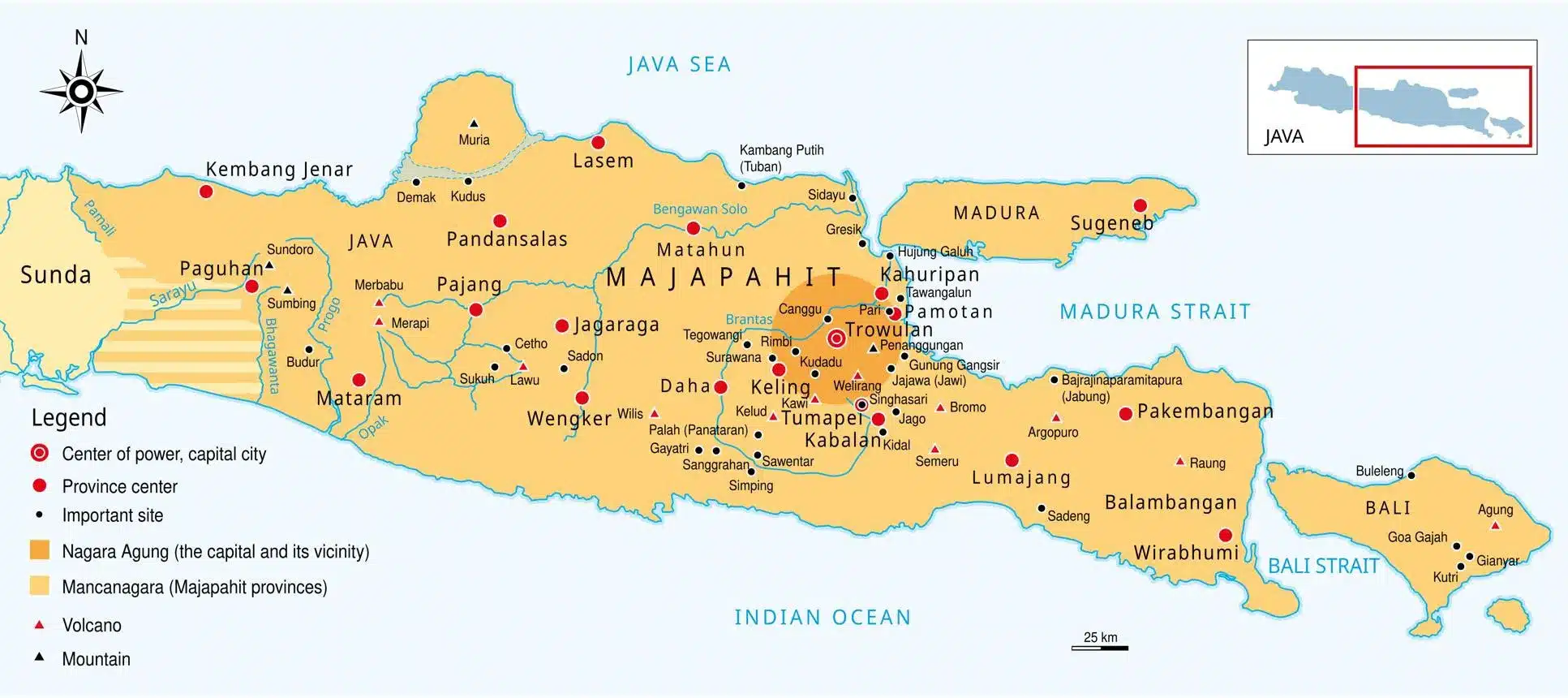
Majapahit later developed into a major kingdom with extensive political, commercial, and diplomatic networks. During the reign of Hayam Wuruk and the influence of Gajah Mada, Majapahit's reach extended across many parts of the Indonesian archipelago and surrounding regions.However, I think it is important to distinguish between territories directly governed by Majapahit and those that maintained political, diplomatic, or tributary relationships with the kingdom. The list of regions in the Nagarakretagama does not automatically mean that all of them were ruled directly in the same way as the administrative territories of a modern state.Over time, Majapahit's power began to change.
One important event was the Paregreg War of 1404–1406, a conflict between two groups within the royal elite, connected to a struggle for power following the death of Hayam Wuruk. The war revealed how fragile relationships within the royal family could become when questions of succession could not be resolved peacefully.Something about this event stands out to me. It feels as though history was repeating a pattern that had already appeared during the time of Airlangga. When Airlangga divided his kingdom into Janggala and Panjalu to address the problem of succession, the decision did not necessarily eliminate future struggles for power. Several centuries later, Majapahit once again faced internal conflict as two groups within the royal dynasty struggled for influence.Of course, these two events were not exactly the same.
Airlangga's division of the kingdom was a decision made to deal with the problem of succession, while the Paregreg War was a conflict between two centers of power within the Majapahit dynasty following Hayam Wuruk's death. Still, both events make me wonder: can dividing power really provide a solution for maintaining political stability, or does it simply create two centers of interest that may eventually turn against each other?Perhaps the real issue is not just how power is divided, but how relationships, legitimacy, and succession mechanisms are maintained among those who inherit it. There is an irony in the history of kingdoms: a decision made to prevent conflict in one generation does not necessarily prevent conflict in the next.The consequences were not limited to the royal court. Internal conflict could also weaken the kingdom's ability to maintain its relationships with the territories under its influence.
At the same time, maritime trade in Southeast Asia was changing. Malacca developed into an important trading center during the fifteenth century. Merchants from various regions, including China, India, Arabia, and the Indonesian archipelago, came together through an increasingly extensive trade network.I find it interesting to consider how changes in major trading centers could influence the political strength of a kingdom. As the ports along Java's northern coast became more independent, their relationships with the center of Majapahit also began to change. Some ports were no longer entirely under the kingdom's political control, even though economic ties with the inland regions continued.For this reason, the decline of Majapahit cannot be explained by a single cause, such as the Paregreg War or the rise of Malacca. Several factors were connected: internal royal conflicts, changing trade networks, the growing independence of coastal ports, and shifting political relationships across the Indonesian archipelago.Malacca itself was still an independent sultanate when it reached the height of its prosperity. The Portuguese only captured it in 1511, under the leadership of Afonso de Albuquerque. In other words, the Portuguese arrived after Malacca had already become an important trading center, not the other way around.

Political changes in Java during the fifteenth and early sixteenth centuries also took place alongside the growth of Muslim communities in coastal areas. However, the process of Islamization did not happen all at once, and it cannot be reduced to a single war between Islam and Hinduism or Buddhism.Muslim communities were already present in several Javanese ports before Demak emerged as a major political power. Trade, marriage, networks of religious scholars, and connections between ports all contributed to the development of these communities.The rise of Demak later changed the political landscape of Java.
The kingdom developed into one of the most important Islamic political powers in the region and expanded into several parts of Java.However, I think we need to be careful when discussing the end of Majapahit. Historical traditions often associate the year 1478 with the fall of Majapahit, but Hindu-Buddhist political power in East Java did not disappear immediately in that year. Other rulers and political centers continued to exist afterward. Demak's conquest of the last major East Javanese center of power is commonly associated with around 1527, although the details and chronology should still be examined critically.I have also come across stories about a ruler such as Suhita supposedly allowing mosques to be built and opposing Hindu and Buddhist religious leaders over the matter of religious tolerance.
These claims need further examination before they can be accepted as historical facts. What we can say more confidently is that Muslim communities were already part of Java's trading environment during the Majapahit period, and that religious and social life at the time was far more diverse than simplified narratives of religious conflict might suggest.Meanwhile, some Hindu-Buddhist communities and traditions continued to survive in both Java and Bali. The migration of certain elites and communities to Bali was one part of this long process of political and cultural change. However, the continuity of Hindu culture in Bali cannot be attributed solely to the fall of Majapahit, since Bali had its own long history and cultural development.
Honestly, I feel that more books like this should also be written and developed by Indonesian historians. It is interesting that one of the writers bringing the story of Majapahit back to a wider audience is actually Herald van der Linde, a Dutch author.Nevertheless, I genuinely enjoyed reading this book. The writing is well-structured and easy to follow, allowing readers who may not have an in-depth knowledge of Majapahit history to understand the connections between historical figures, conflicts within the kingdom, and political changes from one period to another.When I first started reading it, I did not know very much about the history of Majapahit. Perhaps I had heard some of the names before in school history lessons, but my understanding expanded considerably after reading this book.
I was particularly interested in discovering the connections between figures who lived in different periods, the political intrigues within the royal court, and the diplomatic and international trade relationships that existed at the time.One of the things I find most interesting is just how open and extensive connections between different regions already were during that period. Accounts written by foreign merchants and travelers, including Ma Huan, who accompanied Zheng He's expeditions, offer valuable insights into the lives of people and the trading networks that connected different parts of Asia at the time.Beyond politics and trade, I also came across many details about everyday social life. Simple things such as *tuak* (a traditional palm-based drink), young betel nuts, ginger drinks sweetened with palm sugar, and even the presence of Javan rhinoceroses in areas that are no longer part of their main habitat today make history feel much closer and more tangible.
For me, these are precisely the kinds of details that make history fascinating. History is not only about the names of kings, wars, and changes of dynasty. It is also about the lives of ordinary people: what they ate, what they drank, what they traded, what they believed in, and how they interacted with the environment around them.Reading this book has made me think that history is not simply about a past that has already come to an end. It is also a way of understanding how societies develop their cultures, how power operates, and how different values are passed down from one generation to the next.
Perhaps this is why I find myself drawn to reading history. As an artist, I have always felt that understanding culture also means understanding people. And through the story of Majapahit, I have discovered so many layers of human experience: ambition, fear, belief, betrayal, ingenuity, and the desire to leave a lasting mark through power.I hope that more historical books like this will be written, researched, and published in the future, especially by Indonesian writers and historians.Ultimately, this is what makes *Majapahit* by Herald van der Linde an interesting book for me. This Majapahit book review is not simply about evaluating a historical account, but also about reflecting on the human experiences behind the rise and decline of a kingdom.