
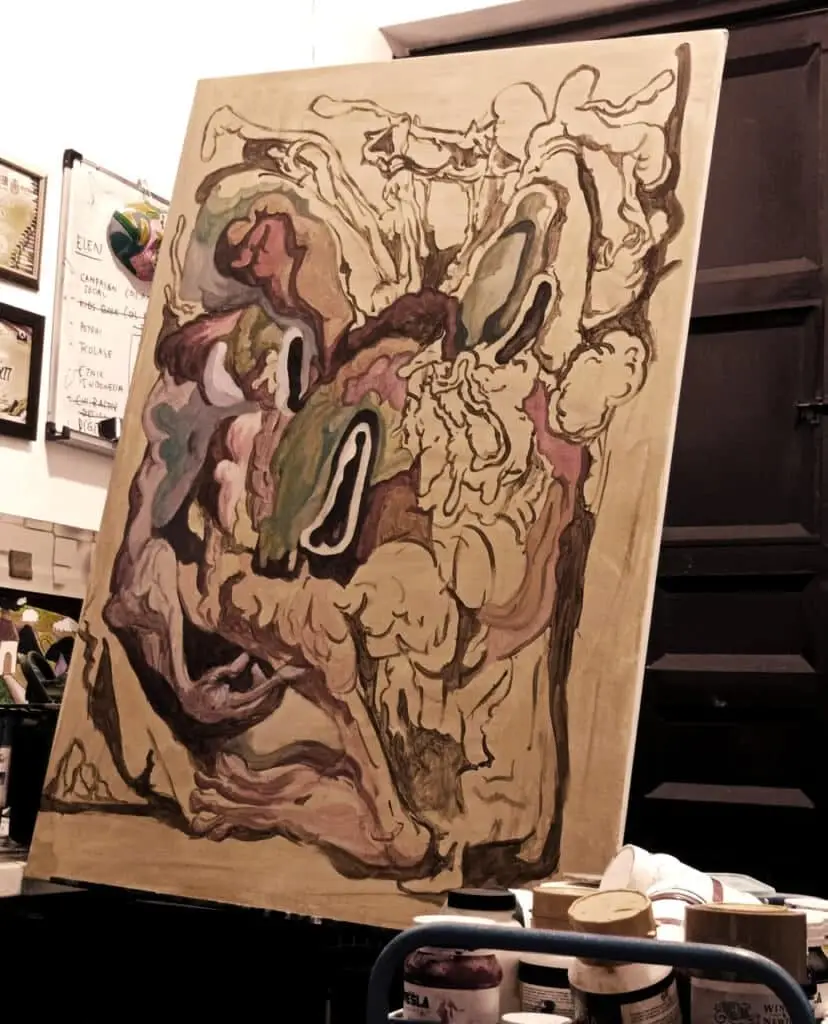
In the past few months, I’ve been constantly reflecting on the idea of subjectivity in art and the place of the artist within it. These thoughts emerged from various conversations with fellow artists and curators. For me, the experience of interpreting an artwork in a gallery is essentially a two-way dialogue between the artist and the viewer—a rich and dynamic form of communication. Yet, no matter how deep the conversation goes, it cannot alter the artist’s fundamental subjectivity in seeing the world.
Interestingly, I recently revisited the ideas of Protagoras. His thinking is deeply tied to the notion of subjectivity; he famously stated that ‘man is the measure of all things.’ This means that the standard of truth is centered on the human being—on one’s perception, experience, and background. Consequently, there is no such thing as a fully universal truth; what exists instead is a truth negotiated through human interaction and the power of argumentation. It is no surprise that Sophists like Protagoras placed great emphasis on rhetoric.
Although Protagoras’s relativism is not the same as apologetics, his rhetorical approach can be used to defend a particular viewpoint—even when it stands in contrast to others. In the realm of art, this way of thinking feels especially relevant: art emerges from the subjectivity of the creator and is then reinterpreted through the subjectivity of its viewers.
Of course, Protagoras’s perspective cannot be applied to scientific disciplines that rely on measurable empiricism. From a scientific standpoint, his relativism is undeniably problematic. Yet outside the empirical realm—particularly in art, values, aesthetics, and perception—subjectivity remains entirely valid. In fact, this has become even more apparent in contemporary society.
Protagoras’s claim was firmly opposed by both Plato and Aristotle. For them, truth, ethics, and knowledge must rest upon universal principles. Truth must possess a logical structure, a moral direction, and a form that can be accepted broadly. This universalistic perspective went on to deeply shape the history of art.
In the visual arts, the influence of classical thought—particularly Greek theories of proportion—becomes evident in the Renaissance era. During this period, art was understood to possess objective standards: anatomical precision, proportional harmony, and compositional balance. Visual ‘perfection’ was regarded as a reflection of the order of the cosmos.
As we enter the modern era, the claim of universality persists but transforms in character. Modern universality no longer refers to cosmic harmony; instead, it rests on rationality, scientific objectivity, and the dominance of Western art institutions in shaping global discourse. Thus, both the Renaissance and modernity assert forms of universality, yet they are grounded in different value systems: one rooted in proportion and metaphysics, the other in rationalization and cultural hegemony.
However, this idea of universality reached a critical point when artists began to question the exclusivity of art institutions and challenge modernism’s claim to objectivity. This deconstructive impulse eventually came to be known as postmodernism. The term ‘postmodern’ first gained popularity in architecture, but the postmodern attitude—rejecting singular standards, resisting grand narratives, and embracing plurality—had already been developing in the visual arts and cultural theory long before the label became widespread.
Artists like Marcel Duchamp, through Dadaism, openly challenged the rigidity of modernism: rejecting fixed structures, the excessive pursuit of originality, and institutional authority. This movement created space for art that is ironic, absurd, and anti-hierarchical.
In the contemporary and postmodern era, subjectivity, deconstruction, and resistance to grand narratives have become dominant. The value of art is no longer bound to a single standard. Artistic discourse has expanded widely and no longer relies on a universal narrative. Returning to Protagoras, we can hear the echo of his thought here: truth is once again placed at the center of the human being. In the context of art, the ‘truth’ of a work is often constructed through argumentation, dialogue, and context.
This is why the role of curators and art critics has become so essential today. In a landscape where artistic subjectivity is commonplace and contemporary artworks are often difficult for the public to interpret, curators serve as mediators. They provide context: who the artist is, their background, the cultural forces that shape them, and the message they seek to convey.
Yet a crucial question remains: does the message truly reach the audience, who each carry their own backgrounds and subjective perspectives? This is where contemporary art encounters its core challenge—within the space between the creator’s subjectivity, the curator’s interpretation, and the diversity of public perception.