
Unraveling “Inner Flow”: The Contradictory Aesthetics of Neo-Abstract Romantic Grotesque
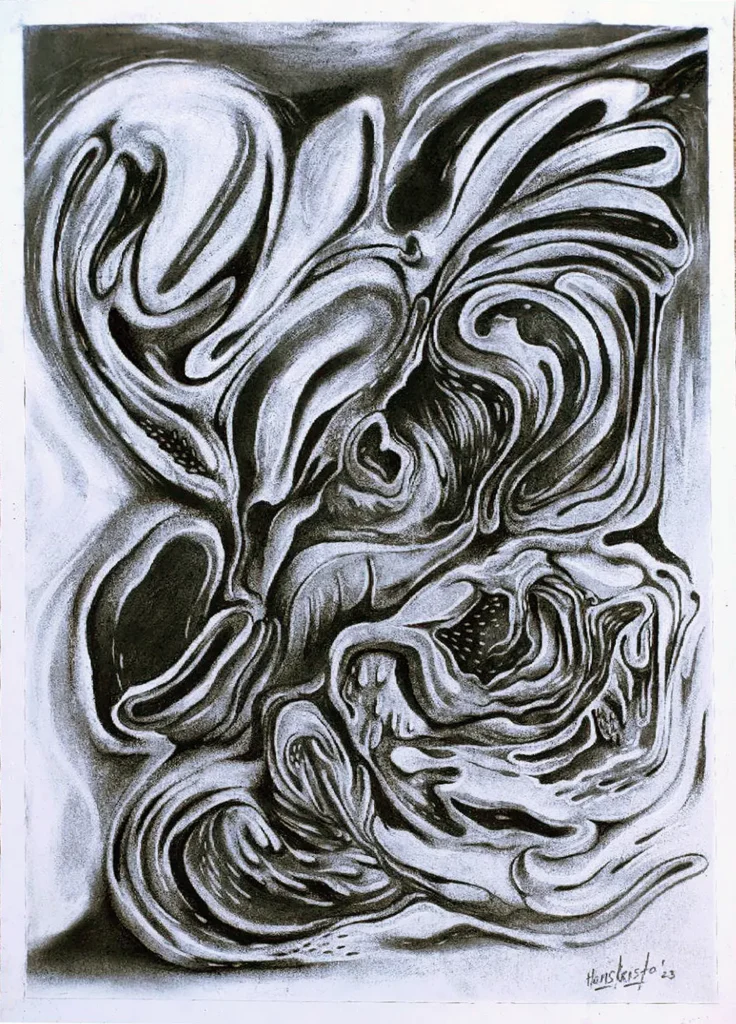
Within the landscape of contemporary art, the boundary between the sublime and the uncanny often dissolves. As a pivotal piece in the Romantic Grotesque series, the artwork titled “Inner Flow” emerges as a compelling visual anomaly. Utilizing a Neo-Abstract approach, the work moves away from representing the tangible world, choosing instead to isolate the raw, psychological tensions of the modern psyche into a new formalistic expression.
In this specific context, the title “Inner Flow” becomes both an irony and a powerful metaphor. The “flow” captured here is no longer a serene, meditative current; rather, it is a visual mapping of a complex internal landscape—a subterranean space where romantic, melancholic longing collides with the jarring, distorted nature of the grotesque.
The Dialectics of Form and Narrative
Visually, the Neo-Abstract framework of “Inner Flow” manifests through elements that are inherently contradictory, yet strangely harmonious:
- Distortion and Linear Elegance: The lines may appear organic, but they carry unexpected fractures, glitches, or erratic rhythms. This represents the “body” or the “mind” undergoing a psychological metamorphosis—a classic hallmark of the poetic grotesque.
- Chromatic Tension: The color palette plays on an intimate friction. Tones that evoke romance and deep intimacy sit alongside intense, jarring saturations, creating an ambiguous atmosphere. It leaves the viewer wondering: is this a celebration of passion, or an expression of underlying anxiety?
- Fluidity of Non-Space: True to the Neo-Abstract philosophy, space within the canvas does not confine objects. Instead, it allows elements to bleed, overlap, and invade one another, mirroring how simulated realities and hyper-emotions intertwine within our consciousness today.
“Inner Flow” is an exploration of how the uncanny, when deconstructed through new abstraction, can birth a form of beauty that is both deeply intimate and hauntingly persistent.
Ultimately, this artwork refuses a linear reading. It is a visual monologue about an internal current that is never entirely pure; it is a space where fragile beauty (the romantic) is forced to dance with a distorted inner reality (the grotesque). “Inner Flow” invites the audience to confront the imperfections, the internal chaos, and the beautifully strange anomalies that ultimately define our humanity in the contemporary era.