
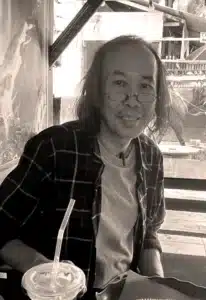
Over the past two weeks, the fine art scene in Medan has been gaining vibrant momentum. An active cross-space collaboration has emerged between Gua Loka and Room C Art Gallery, initiated by a joint exhibition titled “Simpul” (Knot), featuring the works of eight Sumatran artists. The series of events continued with the “Kumpul” (Gather) and “Titik Temu” (Meeting Point) sessions—a public forum where artists presented their concepts to be openly critiqued by the attending audience. The agenda also included an excursion to Franky Pandana’s private collection exhibition at Room C Art Gallery, before concluding with an insightful artist talk.
During the discussion session, public attention was captured by the moderator from the capital. Unassuming in appearance yet possessing an undeniable track record, he unpacked the essence of the exhibition while occasionally dropping provocative statements that sparked the audience’s critical thinking. For me, this moment was a stroke of good fortune, as it allowed me to engage in a long, wide-ranging conversation with him. This marked our second encounter in Medan, following our first meeting when he curated Mella Jaarsma and Nindityo Adipurnomo’s exhibition at Embun Art Room back in 2013.
This warm gentleman, who loves to interweave witty humor into conversations, is no stranger to the Indonesian art world. He is hendro wiyanto, a senior curator whose trajectory spans various national and international exhibition spaces. It is nearly impossible to encapsulate his expansive curatorial portfolio in a single review. Yet, through our brief interactions over those few days, his profound dedication and love for aesthetics shone brightly. His drive to discover aesthetic value often emanates from everyday objects. His organic movements capture this perfectly: he often pauses, pulls out his camera, and frames an oddity overlooked by the untrained eye, only to later accompany it with an unconventional caption. This sharp sensory awareness—a manifestation of pure aesthetic sensibility—is something every artist could stand to relearn from a figure like him. This investigation into sensory experience deeply mirrors the philosophical underpinnings of aisthesis jacques ranciere, where the aesthetic regime of art is mapped through its sensory transformations.
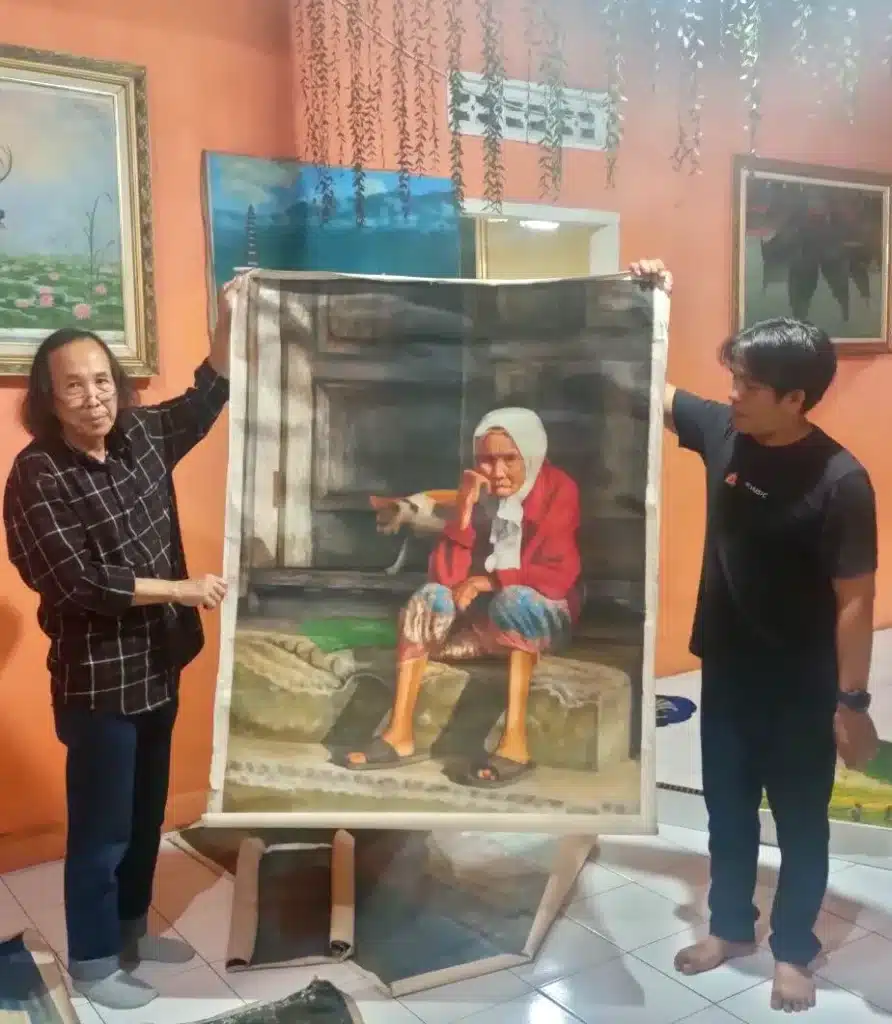
Hendro Wiyanto was born in 1959 in Tuban, East Java, and pursued his fine art education at ISI Yogyakarta from the late 1970s through the 1980s. His fascination with writing and art criticism grew organically within that academic environment. This interest peaked as he observed mass media journalism covering campus exhibitions. He identified a significant methodological gap: the quick, brief reviews of the time failed to capture the conceptual essence of the artworks or the “soul” of the exhibition itself. Hendro believed that art criticism should ideally be produced by individuals who grew up within the ecosystem—someone intimate with and thoroughly understanding of visual dynamics. On the other hand, a pragmatic realization emerged: the path of art writing faced minimal competition compared to the densely packed arena of practicing artists in Yogyakarta at the time.
To sharpen his analytical tools, he later pursued a Master’s degree in Philosophy at the Sekolah Tinggi Filsafat (STF) Driyarkara in Jakarta. This potent combination of a practical art background and rigorous philosophical methodology shaped his distinctively critical character. An artwork was no longer viewed merely as a visual-aesthetic object; instead, it was dissected as an entity deeply intertwined with social, cultural, and political contexts. His sharp insights routinely graced major national mass media outlets such as TEMPO and KOMPAS, as well as international publications like Art Asia Pacific, establishing his voice in criticism and curatorial practice.
Hendro Wiyanto’s historiographical work has also left an indelible mark on the archiving of Indonesian art history. One of his monumental archival discoveries was tracing the earliest domestic usage of the term “curator.” He discovered that the word first appeared in 1986 within the exhibition catalog of Juan Mor’O, a Filipino artist who temporarily lived and worked at ISI Yogyakarta. This archaeological finding confirms that an awareness of the curatorial mediation role had already begun to crystallize within academic art circles long before the term became popularized and widely institutionalized in the following decade.
The evolution of Hendro Wiyanto’s role as an art curator developed outside formal curatorial education channels, given that specific institutions for the profession did not yet exist in Indonesia during his era. Interestingly, the dynamics of independent curation in Indonesia display a sociological anomaly when compared to Western art history. In the West, the independent curator movement was born in the 1960s as a form of resistance against the institutional establishment of museums. Conversely, in Indonesia, this role grew organically precisely due to the lack of representative public art museum infrastructures capable of accommodating contemporary experimentation.
The absence of institutional boundaries ultimately birthed a more self-reliant ecosystem. Curators in Indonesia do not occupy a passive position as mere exhibition administrators. Instead, they position themselves as intellectual dialogue partners for artists long before an exhibition concept fully matures. The curator is actively involved from the initial formulation of an idea, acting as a sounding board to test concepts, up to determining the display layout and spatial dynamics of the exhibition space.
In executing this role, Hendro frequently borrows a legendary metaphor from the global curatorial icon, szeemann harald: that a curator works much like a magician. A curator is demanded to seamlessly integrate the functions of archiving, conservation, and aesthetic provocation. This metaphor reinforces a clear line of demarcation between the art critic and the curator. While a critic arrives to confront a completed artwork directly in the exhibition space, the curator acts as an intellectual dialogue partner who immerses themselves into the volatile dynamics and uncertainties of the artist’s creative process from the very beginning. This ethos echoes the historic milestone of harald szeemann when attitudes become form, where the curatorial act actively transforms into a fluid partnership with the artistic process.
This conceptual foundation intertwines deeply with his academic studies at STF Driyarkara. In his thesis titled Pemikiran Jacques Rancière untuk Seni Emansipatif Indonesia (2023), Hendro posits that aesthetics cannot be separated from politics because both define the distribution of the sensible (distribution du sensible). Drawing from the core ideas of the jacques ranciere politics of aesthetics, art becomes political not because of any propaganda message it carries (heteronomy), but when it succeeds in creating a space of equality and redefining marginalized subjects through its aesthetic autonomy. For Hendro, a true emancipation of art is born from the intersection of autonomous visual form and heteronomously committed social engagement—a dynamic that speaks directly to the discourse of the jacques ranciere emancipated spectator.
Tracing the curatorial trajectory of Hendro Wiyanto is akin to entering a vast labyrinth; it is an impossible task to summarize every exhibition he has guided into a brief review. However, certain moments are far too crucial to overlook. These notes are certainly not intended as a comprehensive historical compilation, but rather as a highly subjective and personal reading of several exhibition fragments that I find most significant in mapping his contributions.
One of the most prominent highlights is his long-standing collaboration with FX Harsono. This artist consistently excavates issues of sociopolitical identity following the collective trauma of May 1998—a dark period that temporarily positioned the ethnic Chinese minority as “the other” in the narrative of Indonesian history. Under Hendro’s curation, that traumatic collective memory was reactivated as both a cultural archive and an aesthetic grievance to demand equality. Beyond Harsono, Hendro’s rigorous curatorial discipline also manifested in the exhibitions of Tisna Sanjaya and Djoko Pekik. These two towering figures in the national art landscape serve as vivid representations of the emancipatory art thesis discussed earlier. Their works successfully bridge mature autonomous aesthetic forms with a heteronomous eco-social commitment. In their hands, aesthetics transform into an instrument to amplify marginalized voices and respond to environmental degradation, aiming to spark tangible change in society.
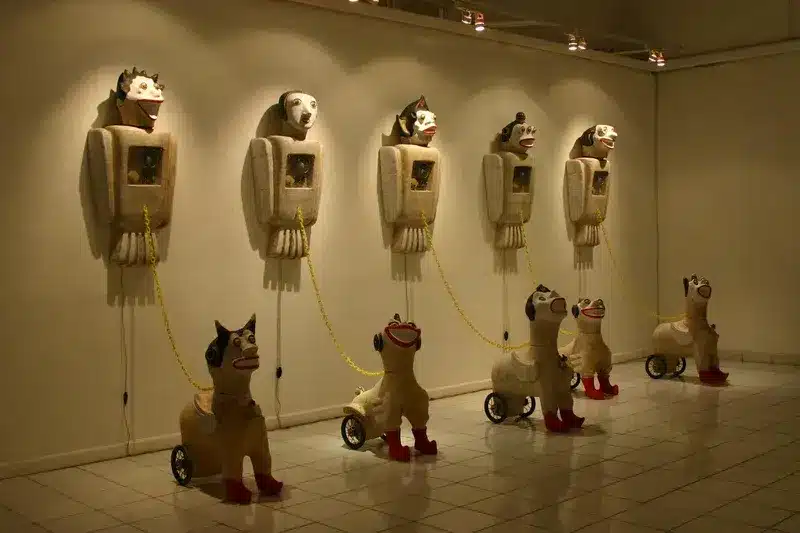
Heri Dono’s satirical installation “Born and Freedom,” which masterfully deconstructs traditional wayang iconography into a sharp contemporary political critique. (Image courtesy of Artsy)
Beyond these names, there is a string of other iconic solo exhibitions that marked pivotal moments in art history, one of which is Heri Dono’s monumental exhibition at the National Gallery of Indonesia in 2004. As a contemporary maestro, Heri Dono consistently reinterprets local cultural heritage—such as the narrative and visual aesthetics of wayang (shadow puppetry)—and provocatively pairs them with contemporary sociopolitical issues. In that major event, Heri Dono summarized a decade of his career (1994–2004), spanning paintings, kinetic installations, and video art. Here, Hendro Wiyanto successfully unraveled the complexities of the artist’s personal mythology, which masterfully deconstructs traditional wayang iconography into sharp, satirically humorous political critiques.
Astute curatorial insights also left deep impressions on Iwan Yusuf’s solo exhibition at D Gallerie (2015) and the exhibition “Jangan Sentuh” (Do Not Touch) at Visma Art Gallery (2017). Iwan Yusuf’s exhibition brilliantly explored the material of fishing nets as a metaphor for the social and ecological interconnectedness of coastal communities. Meanwhile, “Jangan Sentuh” presented a challenging curatorial reading that pushed sensory limits and questioned the physical boundaries of fine art in public spaces. Through this sequence of milestones, one can clearly sense the tangible manifestation of Jacques Rancière’s ideas on emancipatory art. This theoretical awareness is precisely what directs Hendro Wiyanto’s curatorial compass to remain intimately close to works that breathe social, political, and ecological sensitivity.
In addition to solo exhibitions, Hendro Wiyanto’s track record in large-scale public art events deserves thorough exposure. His involvement underscores a profound focus on expanding the conventional boundaries of fine art in Indonesia. On both national and international stages, he actively unpacks the dynamics of the contemporary ecosystem. One of the most phenomenal instances was the Jakarta Biennale 2017, themed “JIWA” (Soul). In this exhibition, Hendro collaborated within a curatorial team alongside Melati Suryodarmo (Artistic Director), Philip Pirotte, Vit Havranek, and Annisa Gultom. Their curatorial process successfully integrated the works of artists across generations and nations, boldly juxtaposing the humanitarian activism aesthetics of the late Semsar Siahaan with younger artists exploring the human body and ecological spaces.
His visionary curatorial stride was also powerfully recorded when he was appointed as the guest curator for the ARTJOG festival for three consecutive years (2023–2025) through a conceptual trilogy titled Motif. The first edition, Motif: Lamaran (Proposal, 2023), was designed to test the reciprocal relationship between the artist and the organizer; artists were “proposed to” to respond to a grand theme through conceptual explorations that challenged the physical limitations of the exhibition space. Meanwhile, Motif: Ramalan (Prophecy, 2024) shifted to dissect non-linear temporal boundaries as an imaginative projection of the future. One of the most striking representations in this edition was the collaborative commission work by Agus Suwage and Titarubi, which utilized a giant ear installation, sound recordings of indigenous tribal prayers, and live rice seed cultivation.
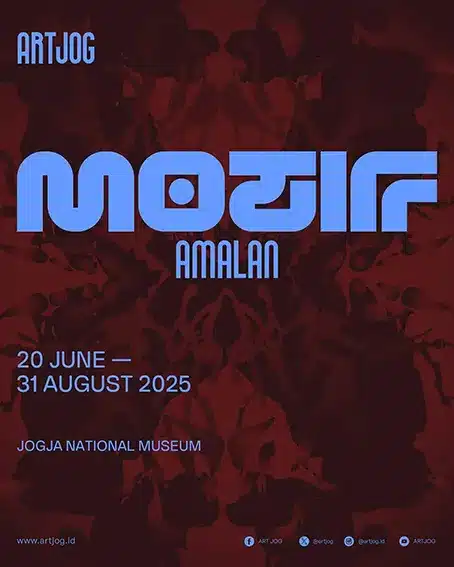
Official promotional poster for ARTJOG 2025 “Motif: Amalan.” Image courtesy of ARTJOG.
The trilogy culminated with Motif: Amalan (Deed/Practice, 2025), which conceptualized art as an act of benevolence, a process of social activation, and a tangible ecological stance, beautifully materialized through Anusapati’s installation of dead trees and roots titled “Secret of Eden”. In this final edition, Hendro offered a profoundly reflective statement:
“War can stop and eliminate art. But to this day, art has not been able to stop war.”
This quote illustrates an honest ontological awareness from Hendro Wiyanto regarding the structural limitations of fine art in instantly altering political realities. Yet, it is precisely within these limitations that the ethical urgency for artists to maintain concrete action resides. He defines “amalan” as a concrete, selfless artistic practice—a sincere reciprocal relationship, much like nature, which constantly gives to humanity without ever expecting anything in return. At this precise junction, he formulates the posture of the ideal contemporary artist.
Hendro Wiyanto’s impact manifests not only through curatorial work in gallery spaces but also through the sharpness of his essays and art criticism published across various mass media outlets. In one of his critical essays for TEMPO magazine around 2003, titled “Di Bawah Panji Bienal, Trienal, dan Festival” (Under the Banner of Biennales, Triennials, and Festivals), Hendro critiqued structural issues within our art ecosystem. He responded to the stagnant state of regeneration following the international breakthrough of the first wave of Indonesian contemporary artists in the early 1990s—such as Heri Dono, Arahmaiani, Dadang Christanto, and Krisna Murti. Regrettably, these pioneers were not immediately followed by a robust second wave of artists. Consequently, a repetition of the same names occurred to satisfy the “universal requirements” of the Western market, even though international interest in Asian art was peaking at the time.
Through this essay, we can witness Hendro’s immense concern for the issue of regeneration and his persistence in seeking out potential artists who have yet to receive the public spotlight. This ideology explains why he willingly travels directly to the regions, including Sumatra, to scout new talents and grant them space on a broader stage. This concrete step was proven when he brought several artists from Medan to participate in the Art Jakarta Papers event.
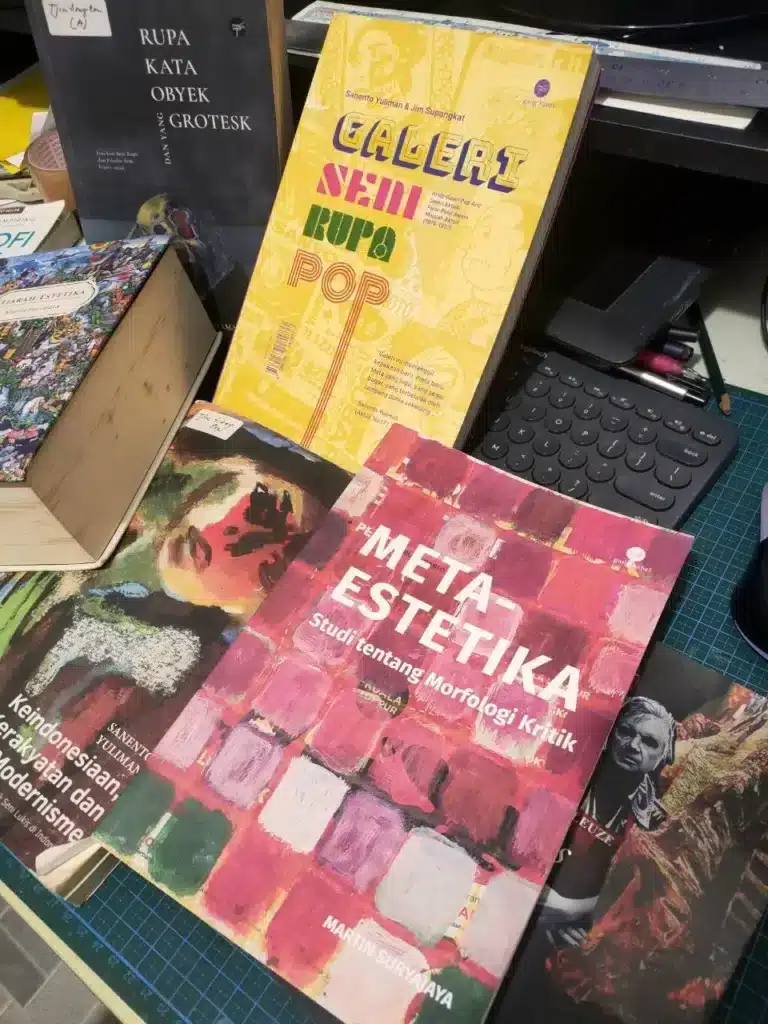
Lately, the ammunition of Hendro’s movement has grown increasingly potent through book publishing. Together with philosopher Martin Suryajaya, he founded Gang Kabel Publishing in 2018. This step represents Hendro’s grand vision to redefine the narrative and discourse of fine art in the country while breaking down the historically low culture of domestic art history literature. Among the many vital titles published by Gang Kabel, several have become part of my personal collection, including:
These books are but a small fragment of the tangible work, love, and absolute dedication of Hendro Wiyanto in preserving the intellectual sanity of Indonesian art history.
That afternoon in Medan, our conversation flowed warmly, transcending the formal boundaries between a senior curator and an artist. Mid-conversation, Mas Hendro offered a technical piece of advice that deeply challenged my creative process: he suggested that I test my medium by working exclusively with monochrome tones first. To me, this advice was far more than a mere visual-aesthetic exercise of black-and-white on canvas; it was an invitation to return to the purity of line, form, and the essence of visual space without the distortions of color that so often deceive the eye. After all, presenting a work that feels entirely “finished” can sometimes feel tedious; there are times when an empty space must be left behind, waiting to be completed by the audience’s imagination within the space of appreciation.
Yet, behind that monochrome recommendation, Mas Hendro slipped in a striking sociological warning regarding an artist’s work discipline. He firmly reminded me to always finish my artworks one by one before moving on to a new idea. “Finish it through to the end first,” he urged. Mas Hendro, who grew up alongside the volatile dynamics of hundreds of Indonesian contemporary artists, deeply understands the psychology of creators who are frequently hijacked by their own creative egos. Artists, according to his observations, possess a tendency to abandon works halfway because they are too quickly seduced by the spark of new ideas that may not yet be mature. The discipline to complete what has been started is the clear line of demarcation that separates artists who merely possess concepts from artists who genuinely nurture their artistic commitment.
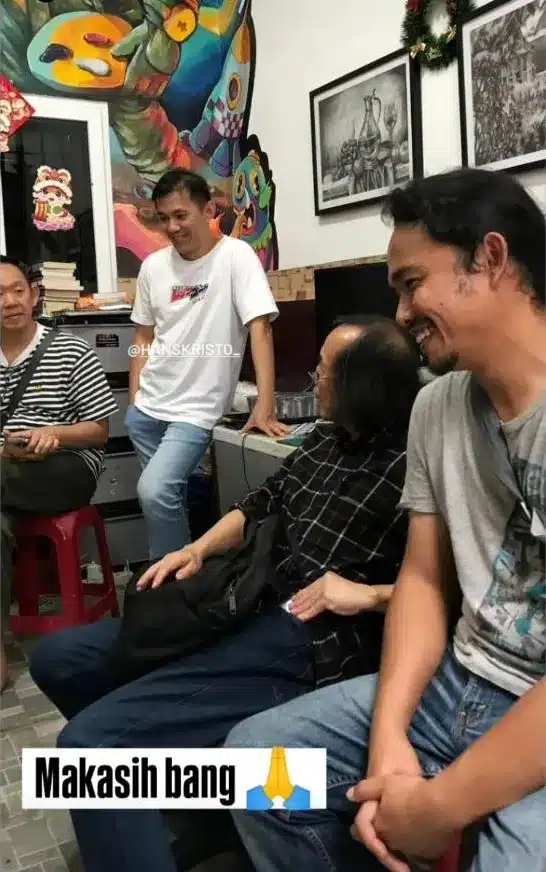
The peak reflection of our encounter that day crystallized around a philosophical message he delivered in an unassuming yet profound tone: that in truth, there is no stratification of aesthetic or artistic value between small-scale and large-scale works. This message instantly reminded me of Mas Hendro’s curatorial methodology in the monumental exhibitions he has directed. In Goenawan Mohamad’s solo exhibition, Di Muka Jendela: Enigma (2021), which he curated, he astutely juxtaposed massive, meter-wide canvases with dozens of tiny sketch drawings on paper measuring a mere 30×40 centimeters inside glass showcases.
Through this approach, Mas Hendro seemed to assert that the power of a work is not measured by the volume of space it consumes on a gallery wall, but by how deeply it builds an intensity of idea and intimacy with the viewer. Large works demand that we step back and take our distance, while small works force us to draw closer and whisper intimately. Both stand as equals before the aesthetic experience. Alongside this advice on scale, he also enriched our discussion by providing invaluable input regarding the creative themes I will carry into my upcoming exhibition.
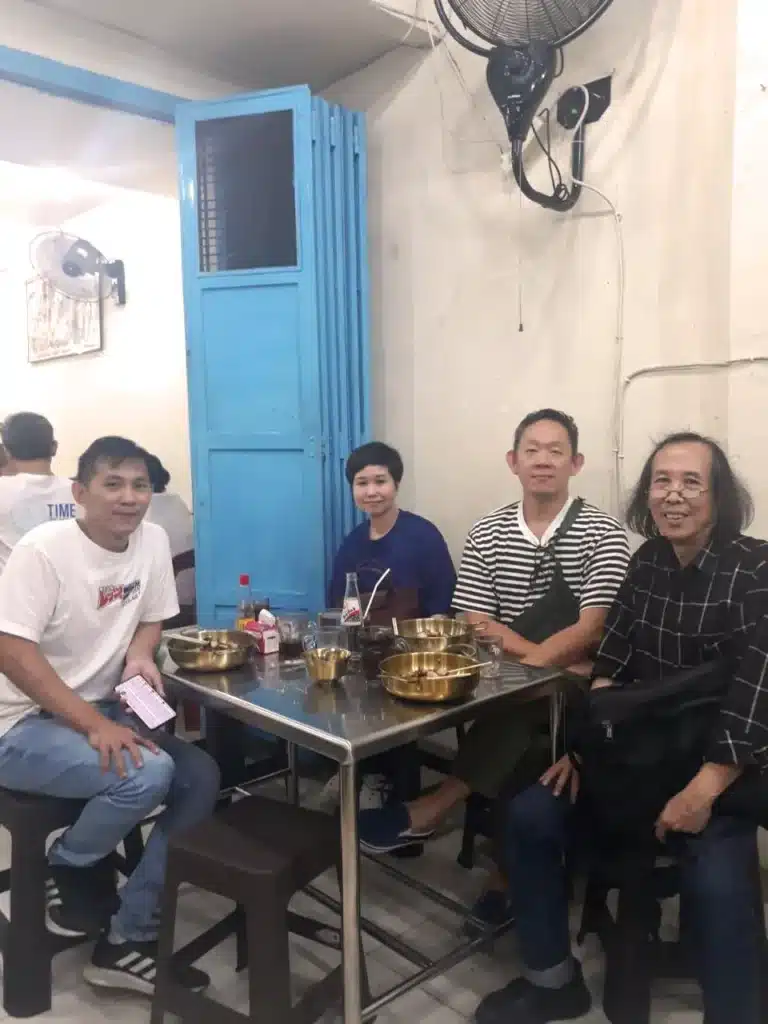
Shared spaces, shared insights: Hans Kristo, Franky Pandana with his wife, and Hendro Wiyanto over dinner in Medan.
Our brief encounter in Medan ultimately left an expansive room for contemplation. Returning home, I carried back not just practical studio tips on monochrome tones and the importance of finalizing a canvas, but a renewed awareness of visual equality. Under his dialogic curatorial guidance, I learned that nurturing an artistic process is about the patience to complete our own artistic “amalan”—no matter how small the scale of the canvas currently facing us.
(Medan, June 2026)
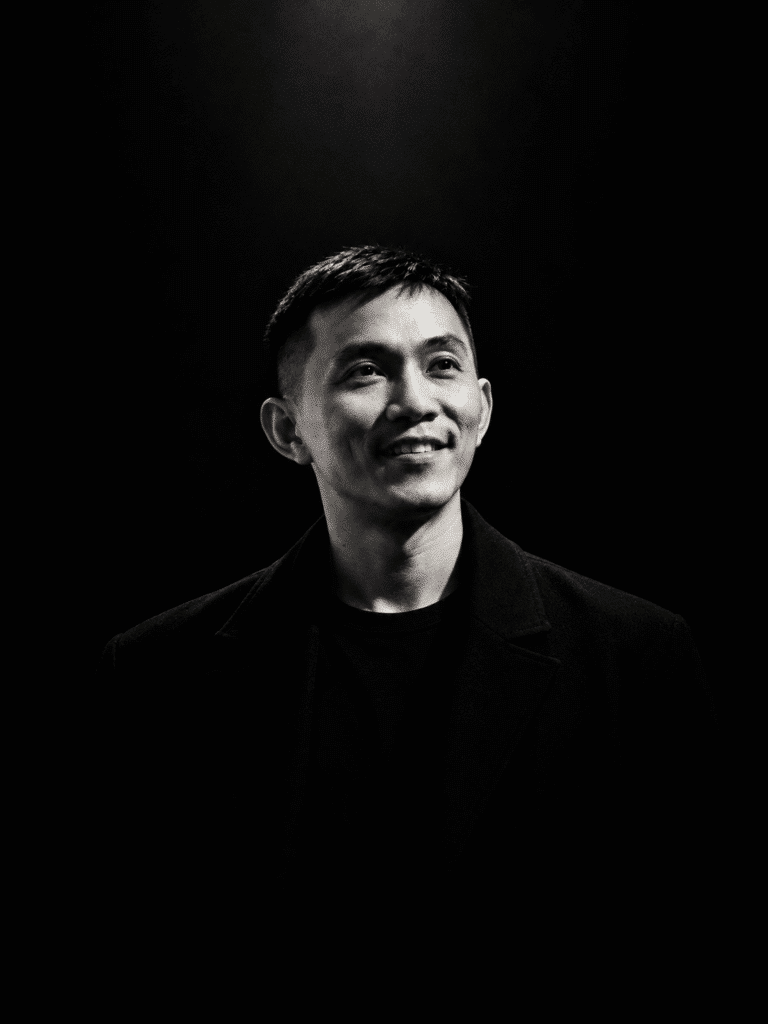
I write about art, aesthetics, philosophy,
and the ideas behind my visual work.