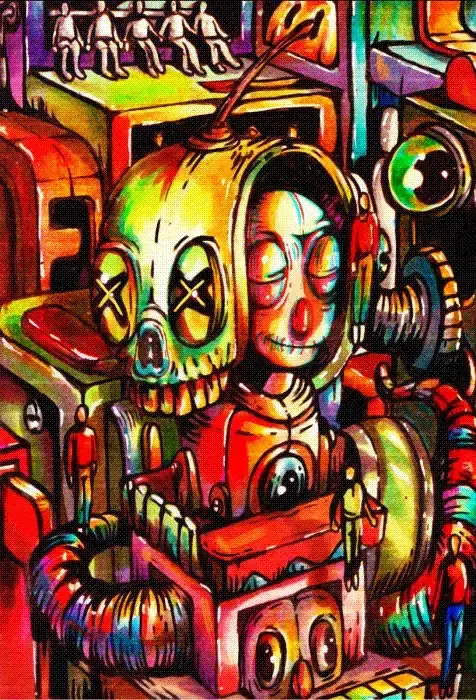
Surreal painting by Hans Kristo showing distorted, human-like figures emerging from abstract layers beneath the surface, symbolizing hidden emotions and subconscious thoughts. The composition blends muted tones with eerie warmth, evoking introspection and quiet unease.

About Hans Kristo: The Surreal Worlds Behind His Art

Who is Hans Kristo?

I was raised in a small town in Sumatra, Indonesia — a trading and port city closely connected to Malaysia and Singapore, part of the dynamic cultural flow within the ASEAN region. Since childhood, I have always been drawn to the world of drawing and art, even though the environment where I grew up lacked a strong fine art infrastructure. After studying in Bandung in the late 1990s, my artistic passion gradually faded, but it reignited in 2005. Since then, I have pursued art consistently and made it the main path of my life.

My six years living in Bali later became a valuable period of learning, especially in discovering the balance between tradition, spirituality, and personal expression. All of those experiences have become an essential foundation that shapes the way I create today.

What defines you as a pop surrealism?

In the early stages of my journey, I spent a lot of time experimenting with different techniques and mediums. Every time I visited galleries or exhibitions, I found myself drawn to works that carried the distinctive tone and color of surrealism. That’s where I began to discover my own direction and visual language.

I’ve always been fascinated by how surrealism allows multiple interpretations — how symbols and metaphors can speak beyond the surface of visual form. Around 2021, I started noticing a shift in my approach: from a more classical surrealism style toward something more vibrant, blending popular icons with a bolder visual spirit.
For me, pop surrealism has become a bridge between spontaneity and reflection — between the real and the imagined.

What emotions or memories does he try to express through your art?

I aim to bring a sense of contemplation into each of my works. Often, they are born out of internal communication — a kind of inner dialogue or unease that’s difficult to put into words. Rather than keeping it inside, I choose to express it through visual form.

Many of them also emerge intuitively and spontaneously. But what fascinates me the most is the distance of interpretation between the artist and the viewer. That’s where the life of an artwork truly lies — when symbols and metaphors open space for multiple meanings, creating a living dialogue between myself and those who experience it.

What inspires Hans Kristo’s artistic vision?

What kind of stories or worlds live inside your artworks?

I never really limit the messages or stories within my works. Yet, I believe each piece captures different stages of my life — what I’ve experienced, what I’ve read, and the people who surrounded me at that time.

I feel that we are never truly “value-free.” We are like pages written by our own experiences and inner forces. Each artwork, therefore, becomes a reflection of what is unwritten — thoughts, intuitions, and hidden emotions.

For me, metaphor serves as a bridge between spontaneity and intention; between the unseen and the measurable. Understanding what lies beneath the surface is often far more compelling than simply following what has already been planned.

Why do your characters often appear dark, yet strangely emotional and human?

You might be referring to “The Parade of Characters” and my character designs.
In truth, I never intentionally planned for them to appear dark. Yet, I consciously try to reveal the fragility within each character I create.

Within their universe — much like in ours — every being carries both light and shadow in balance. They are not perfect, and in that world, there is no true main character.
Everything depends on perspective — on how each of them defines their own existence.

How does memory, imagination, and nostalgia play a role in your work?

In my work, themes of memory, imagination, and nostalgia often emerge because I see life itself as a kind of game. Every game has a beginning and an end — and once one ends, another begins. Even when it looks the same, the message is never identical; there is always something new to learn within it.

At the same time, I feel we often overlook or take for granted the “games” we’ve already played. Through my art, I try to revisit those moments — to give meaning to what has passed, while exploring how memory and imagination intertwine and shape the way we perceive the present.

What does “romantic grotesque” personally mean to Hans Kristo?

Romantic Grotesque is a series I discovered around 2022, during a period when I was deeply exploring form — especially distortion and abstraction. Many of these shapes emerged spontaneously and intuitively, without much planning. 

Over time, I found myself drawn to something in between: a space that bridges the grotesque — dark, odd, and unsettling — with the gentle, almost poetic tone of romanticism.

For me, Romantic Grotesque is about seeking harmony between contradictions — beauty and imperfection, light and shadow, tenderness and strangeness — much like how humans navigate the paradoxes of life. Click here to check ” Romantic Grotesque ” art page.

How did Hans Kristo’s art evolve over time?

How did your style and medium change from traditional to digital or Web3?

In my creative process, I never see medium as a boundary. A medium is merely a tool to convey ideas. Even technique, to me, isn’t something that limits expression. What matters most are the experiences, thoughts, messages, and emotions I want to communicate through my work.

Perhaps that’s why I keep exploring — both in traditional and digital art, across Web2 and Web3 spaces. For me, they are simply different rooms for storytelling. Each medium offers a new way to listen, to feel, and to express the same inner voice within me.

How does you balance fine art roots with pop culture influence?

I believe these two aspects are inseparable. For me, the role of an artist is to offer a perspective from a different angle. We can extract elements from popular culture, twist them, and reintroduce them in a more reflective form. In that way, pop culture becomes more than just a visual trend — it becomes a medium to interpret experience and thought on a deeper level.
To me, the balance between the two creates a space where absurdity and beauty coexist — much like pop surrealism itself.

Do you use AI in your creative process?

I don’t use AI as my main tool or medium. I still value the imperfections and spontaneity of the human hand — the intuition that comes from being human. Those imperfections often reveal honesty in the creative process. However, I understand that many artists have started embracing technology in their work, and that’s completely fine. Personally, I’m more drawn to creative coders, where the human role remains deeply present in the process.

What are the main art collections created by Hans Kristo?

How does Romantic Grotesque differ from Exquisite Aberrations or Homo Ludens?

The Exquisite Aberrations collection is perhaps the closest to Romantic Grotesque, though they differ in tone and atmosphere. Exquisite Aberrations tends to feature darker backgrounds and more intricate details, while Romantic Grotesque takes the opposite direction — lighter colors, fewer details, and a stronger focus on a single emotional form.

Meanwhile, Homo Ludens stands in contrast to both. It is more symbolic, portraying worn-out toys and forgotten objects as metaphors for memory and nostalgia. If Romantic Grotesque speaks about the balance between beauty and strangeness, Homo Ludens explores the playfulness of time and human memory.  “Dive deeper into Homo Ludens, a journey between play and meaning.”

Do all these worlds connect somehow in a shared universe?

Naturally, all these worlds are fragments of myself. They embody everything I have seen, lived through, and dreamt of — the reflections of my own journey.

What messages or emotions does he want viewers to feel?

Does you want people to see beauty inside sadness?

It’s not about finding beauty within sadness itself, but about realizing that within every sense of tragedy or gloom, there lies a moment of reflection — a quiet strength that emerges from it.

Is there a message about memory, loss, or the passage of time?

Not specifically. But I often feel that in our memories, we tend to forget old traces, or they become blurred in a kind of fog. There’s always a space that never feels completely resolved. Sometimes, we fill that space ourselves — weaving exaggerated stories to bring back a sense of romance, or perhaps as a way to heal parts of the past that weren’t so kind.

How has Hans Kristo’s work entered the Web3 art world?

What made him move from traditional galleries to digital platforms?

It happened quite naturally. During the pandemic, my physical movement was limited due to social distancing and working from home. Around that time, I discovered the Web3 world through Clubhouse. I became very active there because I enjoyed the deep and engaging discussions — many of which revolved around Web3 and the celebration of digital art. That’s how I eventually found myself entering this space.

What does he hope to bring to the Web3 art community?

I hope to bridge the gap between physical and digital art through Web3 — to show that both can coexist and support each other. My goal is to sell my physical works using blockchain systems, just like my digital pieces, but also to create meaningful exchanges between collectors and artists in this space. I believe Web3 has the potential to build stronger, more transparent connections between creativity and community.

Where can people see or collect Hans Kristo’s works?

Which platforms feature his collections (Foundation, SuperRare, etc.)?

My works can be collected on several platforms — including SuperRare ,Foundation, Drip, Mallow Art, Exchange Art, and Objkt. In the near future, I also plan to release physical prints and original artworks directly through my website. You can subscribe to my newsletter to receive updates whenever new pieces become available for collection.

Do you also sell physical paintings or limited prints?

Yes, I also sell original physical artworks and limited edition prints through my website. Collectors can find and acquire them directly there.

Where can followers stay updated on his new releases?

You can stay updated by following my social media or subscribing to my newsletter. In the future, every collector who owns my work will be invited to a private Discord server, where they can receive exclusive updates, watch live painting sessions, and interact with me directly.

What’s next for Hans Kristo?

What themes or collections are currently being developed?

I’m currently exploring themes of visual eclecticism — reinterpreting elements from old masterpieces and distorting their forms and meanings. Through this process, I integrate my own visual language, creating a dialogue between classical art and contemporary imagination.

How do you plan to grow as both an artist and storyteller?

I don’t put too much emphasis on strict planning in this area. My storytelling works, like illustrations, are not something I always create consistently. I prefer to see where this exploration naturally leads me. What matters most is that the process never stops — because for me, growth itself lies within the act of continual exploration.

What do you hope people remember when they think of “Hans Kristo”?

I see myself as an artist who is constantly evolving — never stopping in the act of creation and never limiting myself to any single medium. Each medium offers a different experience, and through exploration, I continue to discover new ways to tell stories.


THANSK FOR READING | WWW.HANSKRISTO.COM